Posted on Leave a comment

Bitcoin and Online Veterinary Pharmacy Homelabvet

pay btc online

Bitcoin and Online Veterinary Pharmacy Homelabvet

BTC VeterinaryThe world does not stand still, and with the acceleration of the rhythm of life, we have to make more and more monetary transactions every day, a significant part of which is performed remotely or “at a distance.”  The Internet has mastered this function well.  With the help of electronic payment systems, it is easy and convenient to make financial settlements, pay utility bills and make all kinds of purchases, including Online Veterinary Supplies.

But the speed and availability of this method do not cancel out the old disadvantages of any monetary transactions.  Namely, the lack of anonymity, often unreasonably high bank commission, or the inability to independently track the payment.

A completely new approach

In 2009, developer Satoshi Nakamoto proposed a new electronic money system – Bitcoin (BTC).

The qualitative difference between the new settlement system is the complete anonymity of the participants.  And the absolute transparency of operations, since in the Bitcoin system information about the transfer – and receipt of funds is open.

Bitcoin can be used to pay for any type of product or service.  You can exchange them for the currency of any country or make savings in special wallets.

And also – you can see with your own eyes whether the recipient’s wallet has been replenished after the payment, which excludes any fraud.

Homelabvet is among the first!

animalsToday Homelabvet has begun providing its clients with the ability to make payments, including using Bitcoin.

We are ahead of all our rivals and competitors, and we are the first to offer you a completely new way of making transactions!

Try real security, anonymity, and almost no commission for your purchases!

Additionally, we offer a 20% discount on absolutely all types of goods that you will find on our website for those customers who decide to keep up with the times and make payments using Bitcoin.  This discount is completely transparent and without “hidden fees”, in other words – this additional 20% discount is summed up with any promotion that you see on the site.

How does it work:

pay btc onlineYou see on the web-site a product worth $ 10 and a promotion for the product or a personal coupon for a 20% discount.  Accordingly, applying your coupon or with the help of the promotion, the cost of the goods is not $ 10, but $ 8.  But by paying for this product using Bitcoin, it will become even cheaper by 20%, respectively, $ 8 – 20% = $ 6.4 (this is the price you will get by just paying with Bitcoin).

All other conditions, such as the return of goods and much more, remain the same.  That is, you get an additional 20% discount, while all the conditions for receiving the goods from you remain exactly the same as if you had paid using PayPal, bank card, or direct transfer.

Additional reasons to choose Bitcoin:

  • Ease of registering wallets and their use;
  • Complete confidentiality – a system without personal data;
  • Elimination of fraud on the part of the buyer and the seller (openness and irreversibility of transactions);
  • Low transaction fees;
  • Independence from fluctuations in the national currency rate;
  • Decentralized system.

Instructions for making a payment in Bitcoin:

Bitcoin and Online Veterinary Pharmacy

Are you interested in the new opportunities that Bitcoin offers?  We offer a guide with which you can easily and conveniently pay with bitcoins in the Online Veterinary Pharmacy system:

  1. Having decided on the product that you want to purchase, you need to add it to the cart. Next, you need to place an order in your personal account by choosing the Bitcoin payment method.
  2. After confirmation, your item will have a Pending Payment status. Click on the “Pay for the order” button and you will be redirected to the page with the QR code.

Scan the received QR code and then pay through your Bitcoin wallet. Bitcoin and Online Veterinary Pharmacy

The modern world does not standstill.  The advent of cryptocurrency marks the beginning of an era of anonymous, transparent payments, with minimal fees and no limits.

It sounds like a fairy tale, but today the Bitcoin system together with Homelabvet managed to make the fairy tale come true.

The use of the Bitcoin system opens up many new perspectives.  Make your purchases at Homelabvet comfortably and without outside supervision of your operations and feel truly independent!


You can familiarize yourself with the BTC rate, as well as detailed instructions for beginners on how to create your own wallet, how to make purchases with Bitcoin, and much more on the website:


 coinbase.com


Posted on Leave a comment

Labrador Dog Breed Information + Photo

labrador puppies

labrador puppies

Labrador: all about the breed of dogs with a photo

If you look into his eyes, you will not see a drop of aggression.  The Labrador is considered a guard dog, but it is just as good as companion pets.  He is called an optimist among dogs.  This dog is not an excellent guard or fighter, but it is a real human helper.  Very often, pets do the work of guides.  By nature, they are really kind-hearted, they radiate cheerfulness, you are never bored with them.  The breed is among the most popular in the world.


History of the breed

Researchers has not been able to establish for certain the stages of the origin of this species.  But there are several theories on this score.  Their ancestors are considered to be the Newfoundland dogs who lived on the island of the same name.  And the breed is named after the Labrador Peninsula.  There is also a version that it was named not in honor of the geographical area, but in honor of the labradorite.  This stone has a rich black color and the dogs at first had only this color.  Another interesting theory is that the name comes from the word “labrador”, which means “worker”.  And everyone knows that these dogs are hardworking.  For many centuries, animals have helped people on land, hunting, and at sea.  It is known for sure that the first Labrador dogs were brought to England from the island of Newfoundland.

The opinions of dog handlers differ in the further history of development.  But they believe that it was the Europeans who were actively engaged in the development of the species.  There is also such a theory that only the ancestors of these animals were brought from the island, and the breed itself was bred by English breeders.  And this happened by crossing with black hounds and pointers.  Others speculate that the ancestors of the Labrador Retriever were Viking dogs.  Great interest in these dogs was observed already in the 30-the 40s of the 19th century.  In Birmingham in 1870, even the first exhibition was held, where Newfoundlands and Black Labradors were declared as different breeds.  At this time, dogs became very popular among aristocrats, and repeatedly became members of royal families.  And in 1903, after serious breeding work, the Labrador breed was officially recognized.  The beginning of the 20th century is considered a golden age for this species.  Then they were overwhelmingly popular.

Many nurseries were created in England.  It was during these years that golden-colored dogs became in demand.  The third in demand was a chocolate-colored Labrador retriever.  Gradually, the fame of these beautiful pets spread throughout the world.  Amateur clubs were created in different parts of the world.

labrador dog

Labrador Retriever: breed description

They were bred exclusively as working dogs.  At first, they were indispensable helpers for fishermen.  They helped them pull tackle and fish out of the cold waters.  And today the Labrador is considered the best helper dog for people with disabilities.  They are also often used in various rescue and search operations, and they do this job perfectly well.  Nowadays, these dogs are less often used for fishing, they have long since moved into the category of pets.  Since they are able to give love to all family members.  This is one of the best family dogs.  The Labrador Retriever has a calm disposition, which makes it an excellent therapist among animals.  Very often they provide psychological assistance in centers and clinics where they undergo rehabilitation.  And also in orphanages, and nursing homes.  Excellent helpers not only for fishing but also for hunting.  And all thanks to an acute sense of smell.  The only thing they can’t cope with is guarding the house.  And all because of its friendly nature.

labrador breed

Character

It is difficult to imagine a dog more loyal and affectionate than a Labrador.  They are cute and kind, not only at the age of a puppy but also as adults.  Dogs are always full of energy and ready to have fun with their owners.  They are playful, good-natured, and sociable.  A dog is a real friend of a man – this is an expression about them for sure.  When they are with their families, they are overwhelmed with happiness.  And the dog perfectly feels the mood of people.  If you are in the mood to play, he will happily accompany you.  If you want to have a movie night on the couch, then he will sit quietly next to you.  The Labrador gets along well with children of all ages.  They are ready to play with them and frolic all day.  It also treats other pets warmly, and good friends with cats.  This dog is a real find for novice dog breeders.  Before buying it, it is worth knowing a few points: what are the varieties and colors, the basic rules of keeping, how to feed, the basic rules of education and training, can live on the street or in an apartment, from what age can you take a puppy

labrador 1

Maintenance and care

All dog breeders agree that this dog is very easy to clean.  This applies to both content and training.  They shed throughout the year.

To keep the coat well-groomed, you need to comb the dog daily.  Also, pets are characterized by the so-called dog smell, so they need to be bathed more often than other breeds.  It is also important to keep your ears and teeth clean.  Ears should be wiped with a special solution, and teeth should be brushed weekly.  Can they live on the street?  The answer is yes.  But for this, it is necessary to equip a spacious aviary with an insulated booth.  The dogs also feel good in the apartment.  But they should take a small room or loggia.  The optimal age when you can take a baby Labrador into the family is 3 months.

Labrador Retriever: training and education

These dogs try to please their master in everything.  Therefore, the Labrador is remarkably trainable.  The main thing is to engage in education as soon as you take a small puppy.  And it’s worth remembering that dogs love to play, so it’s best to turn training into an exciting quest.  Having taught the baby the basic commands, you can start learning more complex ones.  You will very quickly notice the growth of the student.

Food: what to feed dogs

Dogs love to eat tightly and because of this they are prone to obesity.  Therefore, you need to strictly monitor nutrition, even when the pet comes to you as a puppy.  Give him more physical activity.  It should be natural feed or cooked food.  Meat, vegetables, and more cereals should be included in the diet.  Under no circumstances should you give pasta or add sweets to your animal.  Otherwise, the dog will increase significantly in size.

How long does a Labrador live? On average, their life expectancy is 10-13 years.  Life span, as in humans, depends on the quality of nutrition, conditions of detention, and health.

labrador best breed

What the breed standard looks like: description

These are strong-built dogs with strong limbs, a broad head, and a voluminous chest.  The ears are mobile, drooping, set far apart.  The eyes are usually brown or hazel, and the expression is good-natured.  Height: in bitches – from 54 to 56 cm, in males – 56-57 cm. What it looks like: wide muzzle, not pointed, straight back, scissor bite.  The tail size is medium, thick at the base.  The coat is thick, short, coarse.  Species and colors chocolate, brown, white, golden, fawn, red Varieties: Chesapeake Bay Labrador straight-haired, curly-haired ,Nova Scotia , Golden Vaccinations

The first should be done at 6-8 weeks, repeated – for puppies at 3 months.  After that, the dog is in strict quarantine for 2 weeks.  To protect the dog, vaccinations are required against: a plague of carnivores, infectious hepatitis, rabies, parvovirus enteritis, parainfluenza, leptospirosis.

labrador

Diseases of dogs

The main diseases: diabetes, obesity, dysplasia, allergy, melanoma, dislocation of the kneecaps, glaucoma, cataract, volvulus retinal atrophy problems with the ureters lymphoma. Some sources of information say about cancer cases. All these cases are rare and treatable by meds for dogs. They could be bought in Online Veterinary Pharmacy.

Labradors Mating

Mating

The minimum age for mating in bitches is 20 months, in males – 18. But experts recommend not to rush with this, as the development of Labradors last longer.  It is best to knit bitches after 3-4 estruses.  The process is carried out on the territory of the male.  Usually – between 10-15 days from the beginning of estrus.

Here you can find a lot of Online Veterinary Supplies for your pet. There are not only toys and sports requisites in Online Pet Pharmacy, but also many other things.

Posted on Leave a comment

Eye care for cats and dogs. Veterinarian advice. Treatment

Ciflodex eye and  ear drops for dogs and cats

Eye care for cats and dogs

Homelab shares tips for caring for the eyes of cats and dogs: what you need to know about prevention, how to recognize anxiety symptoms and what diseases are most common.

eye hygiene in cats
cat eye infection treatment

Eye hygiene in cats

As a rule, the eyes of newborn kittens open after 2-3 weeks. For everyone, this process occurs in different ways: sometimes one eye can open and only then the other, and sometimes both at once. If by the third week your eyes have not opened, you need to start rinsing them with a solution of tea or ordinary boiled water to soften the eyelids. Adult cats are able to take care of their hygiene on their own: their daily self-care includes washing their faces and eyes. But no one is immune from external factors – injuries, dust, worms, heredity and household chemicals. Therefore, you must immediately take your pet to the doctor if you notice alarming symptoms. These include antibiotics for cat eye infection:

purulent discharge; prolonged lacrimation; hard crusts in the corners of the eyes; fur on the face with traces of tears; red or white inner side of the eyelid; visible third eyelid; cloudy or discolored eyes; closed eye (or both).

Some cat breeds are more prone to eye diseases than others. Head of the Center for Veterinary Ophthalmology Alex M. notes: “Champions” in eye diseases are brachycephalic (“flat-faced”) breeds – Persian cats, exotic cats, British, as well as hairless, Siamese and Maine Coons. However, there is probably not a single breed that I would not treat ”. To prevent the development of the disease, regular prevention is necessary.

“Prevention is primarily about adhering to the vaccination schedule, treatments for ecto- and endoparasites,” says John S, an ophthalmologist at the PETMEDS veterinary clinic. – As for the eyes, it is necessary to sanitize (rinse) as the discharge appears – with light, smooth movements, remove the accumulated discharge using a cotton pad moistened with either filtered water or specialized ophthalmic lotions.

eye hygiene in dogs
eye hygiene in dogs

Eye hygiene in dogs

According to ophthalmologist-microsurgeon Alex M, among dogs, eye problems are most common in Pekingese, Pugs, Yorkshire Terriers, Sharpei and Cocker Spaniels. Many eye diseases in animals are transmitted at the genetic level: for example, more than 150 dog breeds suffer from hereditary cataracts, and about 20 breeds suffer from progressive retinal atrophy. Some diseases are very difficult to recognize at an early stage. For example, glaucoma or cataracts are difficult to detect without medical diagnosis, but conjunctivitis or keratitis will become noticeable with eye discharge and redness.

However, the symptoms of diseases may look the same. In such cases, it is very difficult to make a diagnosis on your own, and the wrong treatment can damage the pet. “Let’s take the seemingly simplest situation: a dog’s eye turned red. Everything seems to be very simple. Redness is the first sign of conjunctivitis. The owners begin to drip antibiotics on their own without a doctor’s examination, as a result, the animal may become permanently blind. Why? Because it was an acute attack of glaucoma, which is also accompanied by redness of the eyeball. Such cases occur in my practice every week, ”says David M.

Do’s and don’ts for injuries (eye drops for dogs; what eye drops can I use on my dog?)

In case of eye injury, you should immediately consult a specialist. In this case, you will need to consult an ophthalmologist. If there is no way to come to the doctor, you can try to provide first aid yourself.

“First wash your hands, wipe them with an alcohol wipe. Plant the affected eye towards the light. Using your index finger and thumb, gently pull apart your eyelids and examine the damaged eye. If there is a foreign surface in the eye, it can be removed with a gauze swab. After removing the foreign body, rinse the eye with antibiotic drops – Prodex or “Ciflodex” will do, — (dog eye drops over the counter with a composition of dexamethasone and ciprofloxacin)  recommends David M.

In case of injuries, in no case:

Allowing the animal to rub its eye is irritating. In addition, the animal can further damage the eye and cause infection. If your pet scratches its eye, wear a protective collar over it. They are sold at all pet stores. If there is no pet store nearby, cut the collar out of a 5-liter drinking water bottle (if you have a small animal) or from a plastic bucket (if you have a large one). The collar should be slightly longer than the animal’s muzzle.

Try to forcefully open the injured eye. The risk of additional injury is very high.

Apply on your own eye drops and ointments containing prednisolone or dexamethasone. Without a doctor’s prescription, they can be dangerous and worsen the condition.

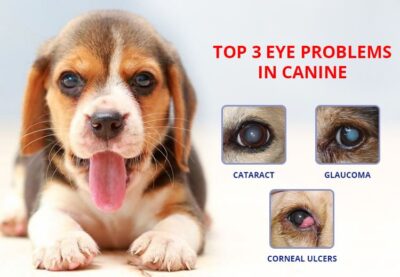
Top Eye Problems In Canine

The most common eye diseases in pets

conjunctivitis  (conjunctivitis eye dogs)

Inflammation of the inner lining of the eyelid, the symptoms of which are redness, swelling of the eye and purulent discharge. There are many possible causes of the disease: infections, parasites, irritating drugs, bruises, foreign bodies, lime dust, smoke, ultraviolet and X-rays, and mold fungi needs cat eye antibiotic.

keratitis

Eye Inflammation, the main symptom is that the eye begins to grow cloudy and watery. The animal’s behavior changes, the pet worries about constant pain, and photophobia develops. Causes: Infection or injury.

Inversion and eversion of the eyelid

Signs: The eyelashes and edge of the eyelid are wet and turned in or turned out. There is lacrimation and redness of the conjunctiva. Because of this, keratoconjunctivitis (simultaneous inflammation of the cornea and conjunctiva of the eye) can develop. Causes: trauma, chemical and thermal burns, microbes, viruses and some parasites.

Сataract (cataract dogs)

A cataract is a clouding of the lens. Its symptoms are not obvious, since the processes take place inside the eye for quite a long time. The lens becomes white or bluish. Cataracts are common in older cats and dogs. In the last stages of the disease, the animal does not see well with the affected eye. Causes: previous infections, as well as inflammation and trauma.

cataract surgery for dogs 

To date, the only effective way to treat cataracts is surgery, which results in the replacement of a clouded lens with an intraocular lens (IOL) or an artificial lens.

Glaucoma

Eye disease caused by increased intraocular pressure. The main symptom is a constant or periodic increase in pressure inside the eye. Symptoms include corneal opacity and decreased sensitivity. In this case, the eye is greatly enlarged and hardened. Causes: complications of deep purulent keratitis, hemorrhage or dislocation of the lens.

Alex M also notes that eyeball injuries are common in animals. This is not necessarily related to fighting – due to their curiosity, dogs and cats often like to dig in the grass during the warmer months. This can be dangerous: according to the ophthalmologist, pets often injure their eyes on the skeleton of cut grass or thorns. The stems are infected with pathogenic microflora, which destroys the surface of the cornea at the site of injury. The infection quickly spreads throughout the eye. In some cases (for example, with panophthalmitis), the eye cannot always be saved.

Homelab recommends that the owner see an ophthalmologist if a disease is detected. This will allow you to help your pet as soon as possible, as well as reduce the risk of relapses and complications. The ophthalmologist advises, for prevention purposes, to bring your pet for an examination once a year until the pet is 7 years old. After 7 years, more often – once every 6 months.