Posted on Leave a comment

Albendazole – the most reliable remedy for worms

Dewormer for cat online shop

Often parasitic worms can infect cats and dogs that eat raw fish, meat, food from a dustbin, and other trash. Animals that spend a lot of time on the streets are also likely to become infected with worms. All pet owners know. “What do I do now?” You can ask. Our shop offers several remedies to treat worm. Albendazole is precisely the main exit to the drug. Let’s see what it is, and why Albendazole is the first choice.

brief information

Albendazole is a drug used for treatment of helminth. It is useful for giardiasis, tricuriasis, filariasis, and ascariasis and other diseases that are caused by parasites. Albendazole was developed in 1975 and is on the list of essential medicines of the World Health Organization. The medicament is intended for oral administration.

How they are infected

German shepherd puppies slightly behind in growth. The body was thin, his head looked too big. But the owner was not worried – the mother of the puppies spent the entire pregnancy in the outdoors, walking a lot, so why be weak? The owner knew I had to give anthelmintics, but as often happens – lost in other concerns. The owner remembered deworming a week before vaccination. She bought suspensions for puppies and tablets by her mother in veterinary pharmacy. Each received a portion of the morning before lunch. And in the evening one of the puppies began to vomit, only to be followed shortly by the second.Something yellow-white long was wiggling into a puddle on the floor. The owner was horrified.

It is unlikely that a pet owner who want to discover something like that . For some reason, everyone thinks it will not affect. This kind of self-complacency is both irrational and dangerous. There are about ten roundworms (nematodes), which affects our cats and dogs. Many of them are very widespread in our country. The best known of all are Toxocara and toksakaris, causing toxocariasis and toxascaridosis. They are involved when talking of worms. They seem to be the same – yellowish white, like a worm, with sharp points. The sample length adult varies from 16 to 18 cm.

Most of his life, adult parasites pass in the upper small intestine. Both nematode species do not adhere to the intestinal wall. In order to stay in his favorite place, they are forced to move continuously against the contraction of the intestine. While dying, worms pass through the intestines and are simply digested by digestive enzymes. Therefore, it is almost impossible to see them in the stool.

What are the outward signs of worms in dogs and cats

separate fragments or whole segments of worms can be found in the stool or wool around the anus. Animals “rides” the bottom. The general condition worsens, there is a lack or an increase in appetite, difficulty swallowing or pain, hair loss, chronic cough. There may be alternating constipation and diarrhea, occasional vomiting.

Note that the symptoms of worm infection are often similar to the effects that occur in most infectious and noninfectious diseases, so for an accurate diagnosis, it is necessary to contact a veterinarian.

How to get rid of worms in animals

There are many different solutions. Albendazole is the most reliable of them all – pay attention to the type of animal that is giving the medicine. Before giving the preparation, the animal should be weighted. Carefully read the instructions on the site and always adhere to the dose!

Albendazole is designed for all types of worms, round and ribbonlike.

In severe cases of worm infection, anthelmintics should only be used under the supervision of a veterinarian.

High efficiency is achieved for the treatment of nematodes, tapeworms. The drug is used for both poly- and mono-invasions.

At the same time, too frequent and unjustifiable use of anthelmintics can damage the immune system and liver. Do not be swayed by frequent use.

Dosage:

Albendazole is used in veterinary medicine. The dosage is selected taking into account the type of animal and its weight:

for the animals

dogs and cats – 0.25 g / 8 kg;

cattle – 0.5 g / 50 kg;

small livestock – 0.5 g / 80 kg;

birds – 0.5 g / 50 kg;

pigs – 0.5 g / 40 kg;

horses – 0.5 g / 100 kg.

See detailed instructions on using albendazole for animals.

Contraindications

The medicine is not recommended if you are hypersensitive to its components. Do not take albendazole during pregnancy and lactation.

Between treatment cycles needed to support a space of at least two weeks, otherwise are possible undesirable consequences.

There are a large number of albendazole sellers on the pet market, one of the quality sellers is Homelab. Albendahelm 500 with active ingredient Albendazole 500. You can buy it and other quality veterinary medicine at Homelabvet.com.

analogs

Albendazole belongs to the group of benzimidazoles. Therefore, the main analogs for humans are mebendazole and thiabendazole. Other anthelmintic agents of this group (fenbendazole, oxfendazole) are only used in veterinary medicine as greater toxicity.

How often must worming cats

To prevent infection, anthelmintics are given from once to twice a year to once every 4 months, depending on the situation. A high risk of infection, for example, when feeding raw meat or offal, fish, eating garbage, or feces on the street – worming can be done once every 3 months.

It is necessary to carry out deworming before vaccination if the last preventive deworming was more than 4-6 months ago.

Can humans get worms cats

82 helminth species recorded in the animals, 32 can parasitize humans. Worms are very easily passed when a person’s hygiene standards are not respected. Cats and dogs are most often infected with toxocariasis, dipylidiasis, toxascaridosis, and hookworms. Three of the aforementioned types of worms are dangerous to humans.

To prevent infection, strictly follow the rules of personal hygiene, do not let animals lick on the face, be sure to wash your hands after contact with animals.


Posted on Leave a comment

Cat parasites

Dewormer for cat online shop

Cat parasites

Even 30 years ago, according to veterinarians, in the USA about 90% of cats were constantly struck at once by several types of parasites. And even now, parasitic diseases are extremely common. If, for example, the owner removes his pet in the summer to the country, the risk of infection of the pet will increase significantly. In addition, there are parasites that live on the body of the animal constantly.
However, lately, veterinary pharmacology has made a big step forward, and the general availability of antiparasitic drugs has increased. Moreover, with adequate medical care, the majority of parasites today are much less dangerous than 30 years ago. But what they are? How does the owner recognize if his pet is infected? What to do in case of their appearance?

What types and types of parasites secrete today?

Most often, parasites are distinguished by their location. So, to external parasites (ectoparasites) include:

  •  Fleas. They live in the coat of the animal.
  •  Lice. Also found in cats fur.
  •  Ear mites (otomycosis). Live in the ears of the animal.
  •  Ixodic ticks. These parasites cat can bring, for example, with a walk.

Also, internal parasites that live in the cat’s gastrointestinal tract are isolated. Various helminths belong to this group: roundworms and tapeworms and flukes, among which nematodes and roundworms are the most common.

What can be dangerous parasites cats?

  1. Some types of parasites that are dangerous for cats can be dangerous for their owners: for example, some types of helminths,  fleas.
  2.  Parasites usually feed at the expense of their host: skin scales, secretions of the sebaceous glands, blood (like a flea or hookworm). This often causes pain and anxiety to the animal, and in severe cases they can cause anemia – anemia.
  3.  Many blood-sucking parasites are carriers of dangerous diseases that can pose a risk to the life and health of a pet. These include, for example, infectious anemia of cats, which is tolerated by both ticks and fleas.
  4.  Fleas can provoke various skin inflammations, and helminths significantly reduce the immune status of cats. 
  5.  A sick pet can infect other animals living in your home.

How to diagnose parasites at home?

The correct answer is no way. The nuances of the diagnosis of parasites are too many, and some of them are too subtle to detect them, especially at first. Therefore, the cat should undergo regular medical examinations in your veterinary clinic, and you should not forget to monitor its health indicators.

Pay close attention to the skin and coat, the state of the mucous membranes, and the quality of your pet’s stool, and if any abnormalities appear, consult a doctor who will be able to correctly diagnose the disease and, if necessary, prescribe treatment.

What symptoms are alarming?

The pet’s treatment is prescribed by a doctor, but you must be vigilant to distinguish signs of possible illness in time.

If you notice any of the symptoms listed below, immediately consult a veterinary specialist:

  •   Helminths or their eggs in the feces or cat vomit;
  •   Fleas, lice, or ticks in cat hair;
  •   Strong scratching and traumatic hair loss;
  •   General lethargy and discomfort of a pet;
  •   Pale mucous, change in color, and texture of feces.

How to prevent infection by parasites?

The comprehensive protection of cats from parasites is to conduct regular preventive measures.

So, to combat internal parasites, it is recommended to use combined anthelmintic agents that effectively protect animals from most worms. As a rule, broad-spectrum preparations in the form of tablets or suspensions in prophylactic doses are used once a quarter.

Prevention of the appearance of external parasites in cats consists mainly of external treatments in the warm season – from May to October. There are a large number of antiparasitic drugs on the pet market, one of them is Helmintazole 200 Pet with active ingredient fenbendazole 200. You can buy it and other quality veterinary medicine at Homelabvet.com.

Nowadays, simple to use and quite effective drops, which are applied to the pet’s skin in the area of ​​the withers, are the most popular. To form stable protection against the entire spectrum of external parasites, it is enough to process the animal once every 3-4 weeks.

For the final determination of drugs for your cat and the frequency of their use, you should consult with your veterinarian.

Posted on Leave a comment

Why dogs lick their owners

panacur for dogs fenbendazole

Dogs lick their owners

Without exception, all dog owners, opening the front door of the house, where their favorite is waiting, foresee a wild delight and an endless number of “kisses” that will shower their four-legged friend from head to toe.

What do these “kisses” mean – infinite love or something deeper? Let’s understand and begin with the origins.

The first such “kiss” is received by the newborn puppy from its mother, who with tongue and muzzle removes the remnants of the fetal membranes and mucus, clearing the airways, helping to begin to breathe independently. During the first weeks of puppy life, she carefully licks them, coping with contamination and keeping the coat and skin clean, removing pathogens that the puppy’s weak immune system can not cope with.

During the games, puppies begin to lick each other, as well as the mother, looking for attention and care and confirming the kinship, the unity of the pack. These memories persist until the end of life.

Appearing in the human house, the dogs begin to lick their loved ones, especially the owner, giving him preference over the rest of the family. Also, dogs can lick themselves in the presence of other people, letting them know that you are their property. This rather amusing sight touches all eyewitnesses.

You, probably, often noticed how, when meeting a dog, you first sniff you thoroughly, and then lick it once. In this way, she brings you to her “base” of smells and tastes. Thanks to the receptors on the tongue and in the nasal cavity of the dog, the next time you will be recognized quickly, “logging in” in a similar way through a kiss.
If your dog has recently become more loving, it is worth thinking, maybe something is bothering her. It is necessary to find out the reason for this behavior. This may be a manifestation of jealousy in connection with the emergence of new animals or replenishment in the family, but it can also be an alarming signal.

If you notice that the animal is licking some part of its body, due attention should be paid to this.

Usually, animals lick their wounds with a lick, which, however, can heal faster due to the action of a bactericidal agent – lysozyme contained in saliva. However, do not let this situation take its course, and the best option would be to receive an appointment with a specialist who will find out the cause of the pathology and help in its elimination. Although saliva contains a substance that inhibits the growth of bacteria, the mechanical effects of the tongue and muzzle can only increase the area of damage and introduce new pathogens that live in the oral cavity.

The owner should be alerted if the animal is bored in the corner of the room and monotonously sucks its paw. It is necessary to distinguish between the bad habits of animals to which they are susceptible due to lack of exercise, and signs of the beginning of the disease. So, the animal can expose the paw, which gives him discomfort. This may be a splinter, obtained during a walk in the woods or a painful itching due to allergies. In such situations, it is worthwhile to contact a specialist as soon as possible and solve the problem of concern to the animal.

If you notice that your dog constantly licks something under the tail, this can be regarded as a norm, and as a pathology. The norm is the period of heat in untreated females who, being neat, take care of themselves. If you are sure that the period of heat has passed, and the animal continues to lick itself constantly, the dog’s general condition also worsens – it becomes more lethargic and apathetic, the appetite decreases – you need to show it to your doctor. This can be a symptom of a problem in the reproductive system, from vaginitis to inflammation of the uterus.

If, however, for such activity you notice a dog – this is always a cause for concern. Usually, unpleasant sensations cause inflammation in the prepuce or pathology of the testes of uncastrated males. Incomplete animals that are unstable in psycho-emotional terms, who have smelled females can also fall into such a state.

It is also worth keeping a calendar of anthelmintic drugs and pararenal gland cleansing in dogs since similar symptoms in the form of skating on the carpet on the pope and licking themselves “under the tail” can speak of helminthic invasion or inflammation of the perianal glands that produce the secret with a strong individual smell. You can buy high-quality anthelmintic drugs and other veterinary medicine at Homelabvet.com.

Every day, pay attention to the peculiarities of the behavior of your pet, look at the spontaneous changes in his reactions. If your pet demonstrates unusual behavior, consider: perhaps this is a reason to contact a veterinary specialist.

Posted on Leave a comment

Emotions expressed without words. Sign language cats

Sign language cats: emotions expressed without words

Cats do not know how to talk, because they do not need it at all. They are quite capable of expressing all their emotions with the help of body language and facial expressions. That is why communication with a cat comes down to understanding its gestures and actions, which can be a whole range.

The body language of cats consists separately of communication using the head, ears, paws, tail, pose and, of course, the eyes. At the same time, communication with a cat should be based on an understanding of the complex of all gestures in general, in addition, the animal always tries to express its emotions quite clearly.

Conventionally, the sign language of cats can be divided into two groups – gestures that are directed directly at the owner (the cat licks his hand, hisses, rushes, rubs), or those that the cat draws as if in relation to itself, but so that the owner could understand her easily.

How to understand the language of cats?

It is not difficult at all, the main thing is to have a little observation. The main group of gestures is associated with a procedure such as licking. It means not only the desire to wash, but it is also a peculiar language of cats with which they can demonstrate:

confusion – the cat begins to lick itself when scolded (this is the best time to communicate with the animal and reconciliation!);

good mood – the cat begins to lick the owner’s hand;

search for affection – the cat carefully licks the owner’s hand and tries to climb onto his lap;

boredom – the cat licks itself with too long, deep, and intense movements: in this way she asks her to caress or play with her;

readiness for training – the cat washes rationally and accurately and is able to accept several commands from the owner.

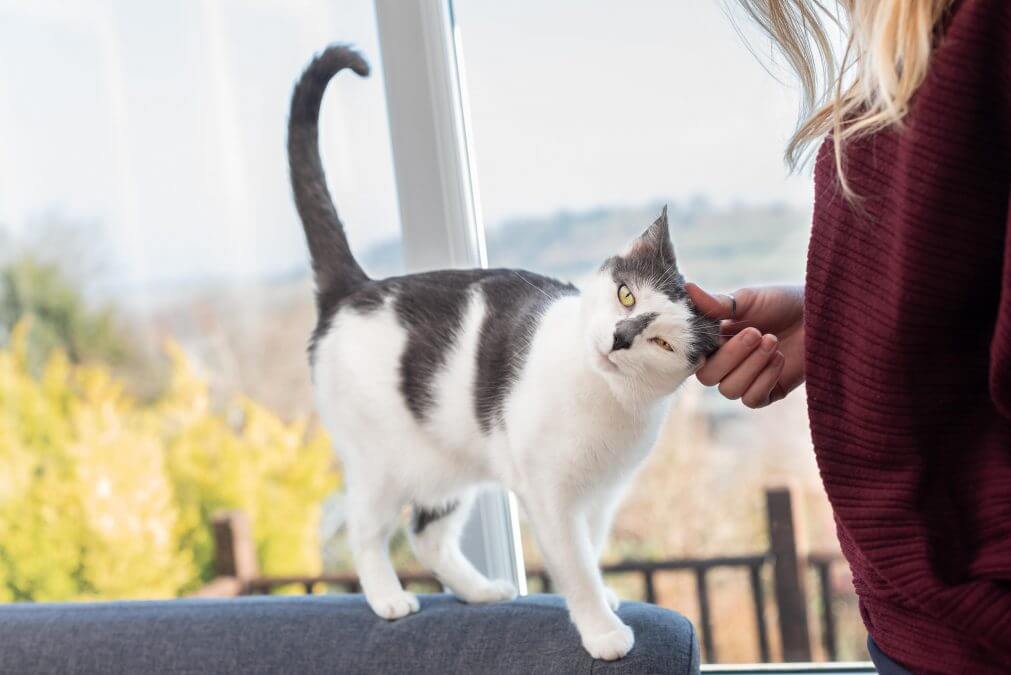
In addition to licking, the language of cats also involves all kinds of body and tail movements. The most common among them is friction on the feet of the owner. In this way, the cat expresses love and can also ask for something. If the cat rubs its face on your face with its nose and pokes its nose on its cheeks or lips, this expresses the extreme degree of its love and appreciation.

As for the tail, it can be in several positions:

flies up – the cat is excited, but not angry and not afraid;

slightly lowered down – the cat is slightly scared or dissatisfied (for example, with its food), in this state it is better to leave it alone;

lowered down – the cat is very scared or unhappy;

actively twitches – the cat wants to be alone (if only the tip of the tail twitches, this is an extreme degree of concern of the animal);

fluffy – the cat is preparing to attack;

sandwiched between paws – the cat is afraid.

Cat Body Language: Key Secrets

In addition, you should monitor the position of the body of cats, which can also express the emotions of your pet. So, about the relaxation, but at the same time, and the attentiveness of the cat says a straight back and a raised head. If the cat sits a little sideways, this indicates that he is scared. A grinning and angry cat full face are about to attack, and if he suddenly crouched down with a grim look, then he changed his mind about doing it.

Similarly, you can interpret the signs that the cat gives with his eyes. The cat’s attention expresses a direct and open look directed directly at you. At the same time, if the cat stares at you too frankly, it expresses a challenge and a requirement to maintain distance. If the eyes are half-closed, the cat is cautious, and if it does become like narrow holes, the cat is confident and alert. You should also be careful if the cat has round pupils and a crazy look – this expresses the fear of the animal, in which it does not control itself. But if the cat looks at you, crouching to the ground, there is no danger, he simply expresses devotion.

Finally, the sign language of cats also involves communication with the help of paws. If a cat rubs a paw on you or gently massages your hand with it, it thus demonstrates satisfaction and contentment. If the cat pulls its paw by the clothes or even fights, then she asks for something, including love and affection.

But the strongest demonstration of love is a hug with paws. The very strong emotion is also expressed when the cat lies on its back – if it puts you in the stomach, then it completely trusts and loves you, so in this position, it should be stroked and caressed – the cat will be very grateful to you!