Posted on Leave a comment

Many Tricks to Help Your Cat and Dog to Get Along

dog and cat helmintazole fenben panacur

When people aren’t debating whether cats or dogs are more intelligent, they’re equating them as mortal foes. That’s a stereotype that both cat expert Jackson Galaxy, host of the Animal Planet show My Cat From Hell, and certified dog trainer Zoe Sandor want to break.

Typically, cats are aloof and easily startled, while dogs are gregarious and territorial. This doesn’t mean, however, that they can’t share the same space—they’re just going to need your help. “If cats and dogs are brought up together in a positive, loving, encouraging environment, they’re going to be friends,” Galaxy tells Mental Floss. “Or at the very least, they’ll tolerate each other.”

The duo has teamed up to host a new Animal Planet series, Cat vs. Dog, which airs on Saturdays at 10 p.m. The show chronicles their efforts to help pet owners establish long-lasting peace—if not perfect harmony—among cats and dogs. (Yes, it’s possible.) Gleaned from both TV and off-camera experiences, here are eight tips Galaxy and Sandor say will help improve household relations between Fido and Fluffy.

TAKE PERSONALITY—NOT BREED—INTO ACCOUNT.

Contrary to popular belief, certain breeds of cats and dogs don’t typically get along better than others. According to Galaxy and Sandor, it’s more important to take their personalities and energy levels into account. If a dog is aggressive and territorial, it won’t be a good fit in a household with a skittish cat. In contrast, an aging dog would hate sharing his space with a rambunctious kitten.

If two animals don’t end up being a personality match, have a backup plan, or consider setting up a household arrangement that keeps them separated for the long term. And if you’re adopting a pet, do your homework and ask its previous owners or shelter if it’s lived with other animals before, or gets along with them.

2. TRAIN YOUR DOG.

To set your dog up for success with cats, teach it to control its impulses, Sandor says. Does it leap across the kitchen when someone drops a cookie, or go on high alert when it sees a squeaky toy? If so, it probably won’t be great with cats right off the bat, since it will likely jump up whenever it spots a feline.

Hold off Fido’s face time with Fluffy until the former is trained to stay put. And even then, keep a leash handy during the first several cat-dog meetings.

3. GIVE A CAT ITS OWN TERRITORY BEFORE IT MEETS A DOG.

Cats need a protected space—a “base camp” of sorts—that’s just theirs, Galaxy says. Make this refuge off-limits to the dog, but create safe spaces around the house, too. This way, the cat can confidently navigate shared territory without trouble from its canine sibling.

Since cats are natural climbers, Galaxy recommends taking advantage of your home’s vertical space. Buy tall cat trees, install shelves, or place a cat bed atop a bookcase. This allows your cat to observe the dog from a safe distance, or cross a room without touching the floor.

And while you’re at it, keep dogs away from the litter box. Cats should feel safe while doing their business, plus dogs sometimes (ew) like to snack on cat feces, a bad habit that can cause your pooch to contractintestinal parasites. These worms can cause a slew of health problems, including vomiting, diarrhea, weight loss, and anemia.

Baby gates work in a pinch, but since some dogs are escape artists, prepare for worst-case scenarios by keeping the litter box uncovered and in an open space. That way, the cat won’t be cornered and trapped mid-squat.

4. EXERCISE YOUR DOG’S BODY AND MIND.

“People exercise their dogs probably 20 percent of what they should really be doing,” Sandor says. “It’s really important that their energy is released somewhere else so that they have the ability to slow down their brains and really control themselves when they’re around kitties.”

Dogs also need lots of stimulation. Receiving it in a controlled manner makes them less likely to satisfy it by, say, chasing a cat. For this, Sandor recommends toys, herding-type activities, lure coursing, and high-intensity trick training.

“Instead of just taking a walk, stop and do a sit five times on every block,” she says. “And do direction changes three times on every block, or speed changes two times. It’s about unleashing their herding instincts and prey drive in an appropriate way.”

If you don’t have time for any of these activities, Zoe recommends hiring a dog walker, or enrolling in doggy daycare.

5. LET CATS AND DOGS FOLLOW THEIR NOSES.

In Galaxy’s new book, Total Cat Mojo, he says it’s a smart idea to let cats and dogs sniff each other’s bedding and toys before a face-to-face introduction. This way, they can satisfy their curiosity and avoid potential turf battles.

Helmintazole, fenbendazole, pets, dewormers

6. PLAN THE FIRST CAT/DOG MEETING CAREFULLY.

Just like humans, cats and dogs have just one good chance to make a great first impression. Luckily, they both love food, which might ultimately help them love each other.

Schedule the first cat-dog meeting during mealtime, but keep the dog on a leash and both animals on opposite sides of a closed door. They won’t see each other, but they will smell each other while chowing down on their respective foods. They’ll begin to associate this smell with food, thus “making it a good thing,” Galaxy says.

Do this every mealtime for several weeks, before slowly introducing visual simulation. Continue feeding the cat and dog separately, but on either side of a dog gate or screen, before finally removing it all together. By this point, “they’re eating side-by-side, pretty much ignoring each other,” Galaxy says. For safety’s sake, continue keeping the dog on a leash until you’re confident it’s safe to take it off (and even then, exercise caution).

7. KEEP THEIR FOOD AND TOYS SEPARATE.

After you’ve successfully ingratiated the cat and dog using feeding exercises, keep their food bowls separate. “A cat will walk up to the dog bowl—either while the dog’s eating, or in the vicinity—and try to eat out of it,” Galaxy says. “The dog just goes to town on them. You can’t assume that your dog isn’t food-protective or resource-protective.”

To prevent these disastrous mealtime encounters, schedule regular mealtimes for your pets (no free feeding!) and place the bowls in separate areas of the house, or the cat’s dish up on a table or another high spot.

Also, keep a close eye on the cat’s toys—competition over toys can also prompt fighting. “Dogs tend to get really into catnip,” Galaxy says. “My dog loves catnip a whole lot more than my cats do.”

8. CONSIDER RAISING A DOG AND CAT TOGETHER (IF YOU CAN).

Socializing these animals at a young age can be easier than introducing them as adults—pups are easily trainable “sponges” that soak up new information and situations, Sandor says. Plus, dogs are less confident and smaller at this stage in life, allowing the cat to “assume its rightful position at the top of the hierarchy,” she adds.

Remain watchful, though, to ensure everything goes smoothly—especially when the dog hits its rambunctious “teenage” stage before becoming a full-grown dog.

Cat vs. Dog Airs on Saturdays at 10 p.m. on Animal Planet

Posted on Leave a comment

Important considerations for Dachshund apartment Living

When living in an apartment, its important to know whether or not the dog breed you have or are thinking of getting will be comfortable and adaptable to apartment life.

In short, dachshunds are wonderful apartment dogs who will generally do just fine within a smaller living space.

Ultimately, you need to know the temperament of your particular dog to know if they will adjust to apartment life.

There are some considerations, however, that you need to be aware of when dealing with dachshunds and apartments. We’ll go through some of those within the article below.

Speak with your landlord

Communication is key and knowing your building’s pet policy is extremely important before signing a lease.

You may love the building and decide that getting a dachshund just isn’t in the cards, or you may simply want to move on to the next apartment that is pet friendly.

The good news is that even if they have size requirements for pets that they allow, a dachshund’s small stature will work in its favor.

You may be required to put an additional deposit down for any damage that may occur from your doxie, however, this is normal and should be stated clearly in your lease.

Don’t be sneaky! There is no way you’re going to be able to keep your dachshund’s presence a secret from your neighbors or landlord.

You will get caught and then you will be forced to move or give up your dog.

Small size is a plus

The most obvious thing going for a dachshund and apartment living is their small size.

It goes without saying that it is much easier having a smaller dog breed living with you in your apartment than a large breed – i.e. a German Shepherd.

Dachshunds won’t knock into everything within your apartment or need a large space to roam.

Providing that they feel comfortable within your apartment and have the necessary items to keep them occupied, their size is ideal for small space living.

Barking

It’s no secret that dachshunds can bark quite a lot and sometimes it can be annoying.

It’s one thing to be annoyed at your dog’s bark within the confines of your house, it’s another thing to have your dachshund barking within an apartment.

You will get to know your neighbors fairly quickly if your dog is barking in your apartment.

They will not be impressed and may take the issue up with you directly (hopefully) or worse file a complaint with the apartment superintendent about the noise of your dog.

Either way, you will have a problem on your hands.

Here are some tips to help with your dachshund barking in your apartment:

Block their view as this will prevent them from getting excited by perceived threats or something exciting they may see in the window.

Give them something to do by providing them with a tennis ball or maybe even better – cutting the tennis ball open slightly and stuffing some treats within it.

This will keep your dachshund occupied for hours as they try and get at the treats.

Exercise your feline friend before you leave for the day. This can do wonders for their restlessness and will tire them out for the morning.

A quick walk in a nearby park or even along the sidewalk outside your apartment will hopefully use up some of their energy.

Blankets are a great idea if your dachshund likes to dig and explore as this will also keep them occupied and busy.

Leave the TV on with low volume if you think this will help your dachshund feel like someone else is with them in the room.

Having them in a crate for a short time may actually settle them down and make them feel secure, thus lessening the chance of them barking.

Seek professional dog training as a last resort if their barking doesn’t seem to be under control.  

If they seem to bark at the slightest noise or movement, even when you’re home with them in your apartment, then you probably need further techniques.

A qualified dog trainer can help with this.

Adaptable

Like anything in life, moving from a spacious home to an apartment will take some adjustment. Is your dachshund a puppy?

Great, it will be fairly easy as they just don’t know any better and apartment life will become the ‘norm’.

But what if your dachshund previously lived in a home with easy access to a yard?

This will be more of a challenge and depending on the age and temperament of your dog you will need to take this into consideration.

Know that dachshunds like to burn off energy, so if you can create a consistent exercise routine of going outside often then you should have no issue with your dog adapting to apartment life.

Apartments can be noisy

Most apartment buildings are located in the city close to traffic, sirens, buses and lots of people.  Do not assume that your dachshund will be ok with his or her new home.

You’ll want to introduce your doxie to these changes slowly and make sure they are comfortable with their new surroundings.

You may need to spend extra time with your dog and provide more leash time for your four legged friend.

Set time aside to give them activity each and every day to ensure their transition to apartment life is a good one.

Need for exercise

Dachshunds don’t necessarily need as much exercise as other dog breeds, however, they are still fairly active and need to burn off energy.

Just because you will be living in an apartment doesn’t mean you should break their routine of going out and exercising often.

Yes, it will take more effort to go down the hallway, into the elevator, and out the building – but it will be worth it.

Your dachshund will love you for it and will make their apartment experience a positive one.

Potty training

Depending on your situation, you may need to consider a pee pad or dog litter box in your apartment until you can successfully potty train your doxie.

Pee pads will usually contain a scent that will attract your dachshund to go on the pad.

Make sure to praise your feline friend when they successfully use it or to place your dog on the pad when its showing the classic signs of needing to go.

Try to find pads that are reusable and washable.

Dog litter boxes can be a square of synthetic grass on top of a tray, a pan that holds litter or can even be actual grass delivered to you by monthly subscription.

You can keep this in the corner of your apartment or even put it outside on your balcony if possible.

Vaccinations

Ensuring your dachshund is free of parasites and vaccinated is extremely important within an apartment complex.

Should the worst happen and your dog bites someone, you’ll need to prove that it was vaccinated.

Because you are going to be on shared common areas and interacting with children and other folks, this is very important and you shouldn’t neglect this task.

Other dogs within building

Get to know your neighbors and tenants within your building so that you can network with other dog owners.

Dogs like to have companionship and maybe its possible you can coordinate your dog walks with another dog so that your dachshund has someone to be friends with.

Sometimes there is a teenager or retiree who would be more than happy to walk your dog. It could be complimentary or you could pay them a small amount for the gesture.

What’s great about being in an apartment is the proximity to everyone, so there is a better chance of getting to know people compared to being in a house.

First floor

Do you need to be on the first floor when you own a dog in an apartment? Not necessarily, but having said that it would certainly help.

If you can simply open your sliding door and walk out to the common areas with your dog it can be tremendously convenient.

Obviously there are downsides to a first floor apartment unit, namely security and increased noise from outside.

Having said this, all the benefits that come with it for dog owners may be worth it.

Setting up rules and guidelines

You’re going to be living in a confined space. This doesn’t mean that your dog gets to takeover your apartment.

You’ll need to train your dachshund to know if its OK to lounge on your sofa or pick a spot on your bed.

Set up clear guidelines and training for your dog when it comes to your apartment space.

Just because the space is smaller, doesn’t mean that you should forego rules as to what areas of the apartment are off limits.

Reassure neighbors

Your neighbors may be dog people already or they may not. Be proactive and introduce your doxie to them whenever you can.

It’s important that they know that you are training your dog within your apartment and that you take care of it with love and direction.

Give them your cell number or email address and ask them to contact you should there be any issues with barking or anything else that is of concern.

This will put them at ease and show that you are a responsible dog owner.

Conclusion

Dachshunds love affection and companionship.

Whether that means they are close to you in an apartment or house is of no consequence to them providing they feel loved and wanted.

If you are often away from your home, then this will cause more of a problem in an apartment then it would a house.

I would advise against having any dog in an apartment if it will be left alone for long periods of time.

With regular exercise, interaction, potty training and play time, your dachshund will adjust very well to apartment life.

Posted on Leave a comment

Dog obesity and fat dogs. How to lose weight?

Dog obesity and fat dogs

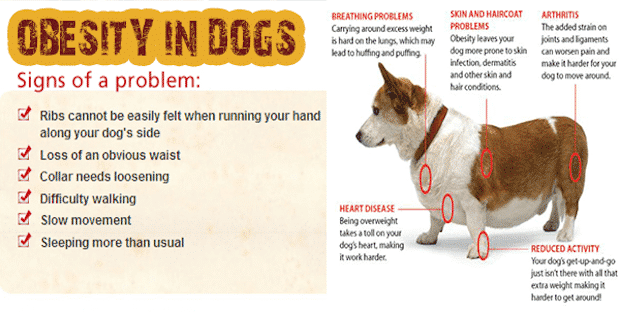
In North America, obesity is the most common preventable disease in dogs. Approximately 25-30% of the general canine population is obese, with 40-45% of dogs aged 5-11 years old weighing in higher than normal.

What is obesity?

Obesity is an accumulation of excess body fat. Extra body weight and extra body fat tend to go hand in hand, so most overweight dogs will have excess body fat.

Body weight is easy to measure when assessing if a dog is overweight or obese – easier than trying to measure body fat. Using body weight as a guide, dogs are considered to be overweight when they weigh 10-20% above their ideal body weight. They are considered obese when they weigh 20% or more above their ideal body weight.

What are the risks with obesity?

Obesity shortens a dog’s life and makes them more likely to develop disease. It was always accepted that heavy dogs lived a shorter lifespan than lean dogs, usually by 6-12 months. But a large, lifetime study of Labrador Retrievers has found that being even moderately overweight can reduce a dog’s life expectancy by nearly two years compared to their leaner counterparts. This is a sobering statistic.

Previously, fat was considered to be relatively inactive tissue, simply storing excess energy calories and adding to body mass. However, scientific evidence now reveals that fat tissue is biologically active. It secretes inflammatory hormones and creates oxidative stress on the body’s tissue, both of which contribute to many diseases. Thinking of obesity as a chronic, low-level inflammatory condition is a new approach.

“Excess fat negatively impacts a dog’s health and longevity.” 

Obese dogs develop an increased risk for:

  • many types of cancer, diabetes mellitus, heart disease, and hypertension
  • osteoarthritis and a faster degeneration of affected joints
  • urinary bladder stones
  • anesthetic complications as they are less heat tolerant

On the other hand, obesity may be an indicator of disease, such as hypothyroidism (an underactive thyroid gland) or Cushing’s disease (overactive adrenal glands).

How do I know if my dog is obese?

The very first step in dealing with an overweight or obese dog is to recognize and acknowledge that there is a problem. Unfortunately, we are inundated with images in the media of dogs that are consistently too heavy, which makes it challenging to understand what normal looks like. Your veterinarian and veterinary health care team can assist with an assessment.

Rib coverage is not only an important measurement to help you identify if your dog is overweight, but it is also easy for you to do at home, on your own. If you hold your hand palm down and feel your knuckles with the flats of the fingers on the opposite hand, this is how your dog’s ribs should feel just behind the shoulder blades. It is also a good method for measuring weight loss progress between formal weigh-ins.

Your veterinary health care team will provide an estimated ideal body weight to use as a target, but it is important that they also do regular body condition assessments to ensure progress is being made toward normal body weight and body condition. Most veterinary practices use a body condition scoring system on a scale of either 1-5 (3 is normal) or 1-9 (4.5 is normal).

How do I adjust my dog’s meals to help him lose weight?

Once you have identified that your dog is overweight or obese, it is important to adjust feedings specifically for weight loss –  using a specific nutritional product, a specific portion, and a specific meal frequency. There are scientifically formulated nutritional products to help with healthy and safe weight reduction in dogs such as Hills® Prescription Diet® Metabolic, Royal Canin® Satiety Support Weight Management, and Purina Overweight Management®. It is not appropriate to simply reduce the volume of their current food. This will cause malnourishment over time.

It is appropriate and important to feed a nutritional product that has lower overall calorie density, yet maintains an appropriate nutrient balance. Your veterinary health care team can help you determine which nutritional products are best for your dog.

Once the new food has been selected and the new portions are determined, it is critical that you be consistent with feeding –  portions and meal frequency – and to resist the temptation to provide inappropriate snacks. Treats should make up no more than 10% of your dog’s daily calorie intake. Fresh or frozen green beans, broccoli, and cauliflower, as well as air-popped popcorn all make excellent snacks if approved by your veterinarian.

“It is not appropriate to simply reduce the volume of their current food. This will cause
malnourishment over time.”

Regular weigh-ins, every 2-3 weeks (or at minimum once per month), are an important component of successful canine weight loss and it keeps everyone accountable – Weight Watchers® has been using this principle for decades. It is important to verify weight loss, to ensure that weight loss is neither too rapid nor excessive, and to determine when enough weight has been lost.

For further tips on reducing your dog’s weight, see the handout “Creating a Weight Reduction Plan for Dogs” and “Walking Your Dog for Weight Loss”.

What happens when we reach our weight loss goal?

Once an ideal body weight and condition has been achieved, it is important to maintain that weight. Once again, your veterinary health care team can help you find an appropriate food and portion for weight maintenance.

Portion control is critical at this stage to prevent regaining weight. After so much hard work, a relapse in obesity would be disappointing. Yo-yo weight loss and gain is no healthier for dogs than for humans. The benefits of normalizing body weight and condition make the effort well worth it.

Posted on Leave a comment

The love of a dog – research

The love of a dog

According to new research, the love of a dog is a much deeper appreciation for the food.

Dr. Gregory Burns (Gregory Berns) is ready to dispel the controversy about dogged loyalty. According to the New York Times, neuroscientists have taken a thorough look at the functions of the brain of dogs to learn more about what dogs really think, and tell Dr. Gregory on the results of his research in his book What it means to be a dog. What was new for him to learn? First, the dog loves a man, not only because it feeds…

Dr. Burns undertook this work after losing his own dog, pug Newton. After Newton’s death, the doctor began to ask himself more and more about what the dog was thinking about him.

In their experiments, Dr. Burns, he sets out to find out if dogs use their brain functions as people.

” We have conducted an experiment in which dogs were given a hot dog, and sometimes simply praised. By comparing their reactions, we saw many dogs respond to praise and food in the same way, “said the doctor.

The study results, Dr. Burns concluded that dogs love their owners, at least as much as food. 
Of all the dogs involved in the study, 20% showed increased activity when brain function is used to respond to praise, and this may mean that these dogs love attention from their owners more than the food you give them.

In addition, Dr. Burns, dogs also showed pictures of various objects and people and found that a separate part of the brain was involved in processing faces. This means that initially the brains of dogs were created to process and perceive individuals.

You can buy some treatments for your pets HERE.

Posted on Leave a comment

Albendazole – the most reliable remedy for worms

Dewormer for cat online shop

Often parasitic worms can infect cats and dogs that eat raw fish, meat, food from a dustbin, and other trash. Animals that spend a lot of time on the streets are also likely to become infected with worms. All pet owners know. “What do I do now?” You can ask. Our shop offers several remedies to treat worm. Albendazole is precisely the main exit to the drug. Let’s see what it is, and why Albendazole is the first choice.

brief information

Albendazole is a drug used for treatment of helminth. It is useful for giardiasis, tricuriasis, filariasis, and ascariasis and other diseases that are caused by parasites. Albendazole was developed in 1975 and is on the list of essential medicines of the World Health Organization. The medicament is intended for oral administration.

How they are infected

German shepherd puppies slightly behind in growth. The body was thin, his head looked too big. But the owner was not worried – the mother of the puppies spent the entire pregnancy in the outdoors, walking a lot, so why be weak? The owner knew I had to give anthelmintics, but as often happens – lost in other concerns. The owner remembered deworming a week before vaccination. She bought suspensions for puppies and tablets by her mother in veterinary pharmacy. Each received a portion of the morning before lunch. And in the evening one of the puppies began to vomit, only to be followed shortly by the second.Something yellow-white long was wiggling into a puddle on the floor. The owner was horrified.

It is unlikely that a pet owner who want to discover something like that . For some reason, everyone thinks it will not affect. This kind of self-complacency is both irrational and dangerous. There are about ten roundworms (nematodes), which affects our cats and dogs. Many of them are very widespread in our country. The best known of all are Toxocara and toksakaris, causing toxocariasis and toxascaridosis. They are involved when talking of worms. They seem to be the same – yellowish white, like a worm, with sharp points. The sample length adult varies from 16 to 18 cm.

Most of his life, adult parasites pass in the upper small intestine. Both nematode species do not adhere to the intestinal wall. In order to stay in his favorite place, they are forced to move continuously against the contraction of the intestine. While dying, worms pass through the intestines and are simply digested by digestive enzymes. Therefore, it is almost impossible to see them in the stool.

What are the outward signs of worms in dogs and cats

separate fragments or whole segments of worms can be found in the stool or wool around the anus. Animals “rides” the bottom. The general condition worsens, there is a lack or an increase in appetite, difficulty swallowing or pain, hair loss, chronic cough. There may be alternating constipation and diarrhea, occasional vomiting.

Note that the symptoms of worm infection are often similar to the effects that occur in most infectious and noninfectious diseases, so for an accurate diagnosis, it is necessary to contact a veterinarian.

How to get rid of worms in animals

There are many different solutions. Albendazole is the most reliable of them all – pay attention to the type of animal that is giving the medicine. Before giving the preparation, the animal should be weighted. Carefully read the instructions on the site and always adhere to the dose!

Albendazole is designed for all types of worms, round and ribbonlike.

In severe cases of worm infection, anthelmintics should only be used under the supervision of a veterinarian.

High efficiency is achieved for the treatment of nematodes, tapeworms. The drug is used for both poly- and mono-invasions.

At the same time, too frequent and unjustifiable use of anthelmintics can damage the immune system and liver. Do not be swayed by frequent use.

Dosage:

Albendazole is used in veterinary medicine. The dosage is selected taking into account the type of animal and its weight:

for the animals

dogs and cats – 0.25 g / 8 kg;

cattle – 0.5 g / 50 kg;

small livestock – 0.5 g / 80 kg;

birds – 0.5 g / 50 kg;

pigs – 0.5 g / 40 kg;

horses – 0.5 g / 100 kg.

See detailed instructions on using albendazole for animals.

Contraindications

The medicine is not recommended if you are hypersensitive to its components. Do not take albendazole during pregnancy and lactation.

Between treatment cycles needed to support a space of at least two weeks, otherwise are possible undesirable consequences.

There are a large number of albendazole sellers on the pet market, one of the quality sellers is Homelab. Albendahelm 500 with active ingredient Albendazole 500. You can buy it and other quality veterinary medicine at Homelabvet.com.

analogs

Albendazole belongs to the group of benzimidazoles. Therefore, the main analogs for humans are mebendazole and thiabendazole. Other anthelmintic agents of this group (fenbendazole, oxfendazole) are only used in veterinary medicine as greater toxicity.

How often must worming cats

To prevent infection, anthelmintics are given from once to twice a year to once every 4 months, depending on the situation. A high risk of infection, for example, when feeding raw meat or offal, fish, eating garbage, or feces on the street – worming can be done once every 3 months.

It is necessary to carry out deworming before vaccination if the last preventive deworming was more than 4-6 months ago.

Can humans get worms cats

82 helminth species recorded in the animals, 32 can parasitize humans. Worms are very easily passed when a person’s hygiene standards are not respected. Cats and dogs are most often infected with toxocariasis, dipylidiasis, toxascaridosis, and hookworms. Three of the aforementioned types of worms are dangerous to humans.

To prevent infection, strictly follow the rules of personal hygiene, do not let animals lick on the face, be sure to wash your hands after contact with animals.


Posted on Leave a comment

Emotions expressed without words. Sign language cats

Sign language cats: emotions expressed without words

Cats do not know how to talk, because they do not need it at all. They are quite capable of expressing all their emotions with the help of body language and facial expressions. That is why communication with a cat comes down to understanding its gestures and actions, which can be a whole range.

The body language of cats consists separately of communication using the head, ears, paws, tail, pose and, of course, the eyes. At the same time, communication with a cat should be based on an understanding of the complex of all gestures in general, in addition, the animal always tries to express its emotions quite clearly.

Conventionally, the sign language of cats can be divided into two groups – gestures that are directed directly at the owner (the cat licks his hand, hisses, rushes, rubs), or those that the cat draws as if in relation to itself, but so that the owner could understand her easily.

How to understand the language of cats?

It is not difficult at all, the main thing is to have a little observation. The main group of gestures is associated with a procedure such as licking. It means not only the desire to wash, but it is also a peculiar language of cats with which they can demonstrate:

confusion – the cat begins to lick itself when scolded (this is the best time to communicate with the animal and reconciliation!);

good mood – the cat begins to lick the owner’s hand;

search for affection – the cat carefully licks the owner’s hand and tries to climb onto his lap;

boredom – the cat licks itself with too long, deep, and intense movements: in this way she asks her to caress or play with her;

readiness for training – the cat washes rationally and accurately and is able to accept several commands from the owner.

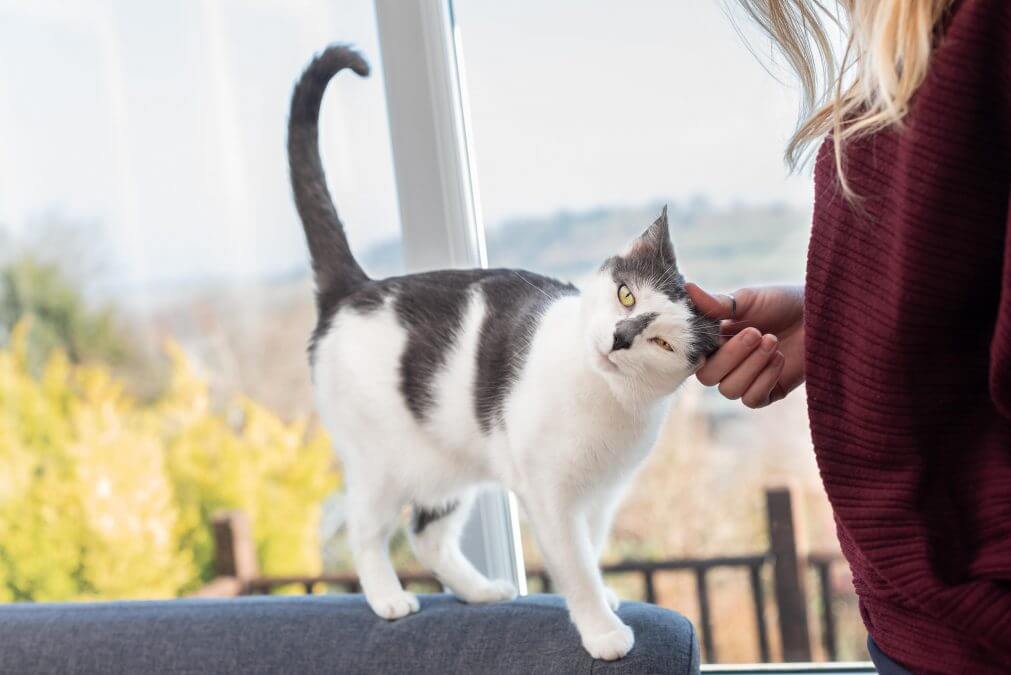
In addition to licking, the language of cats also involves all kinds of body and tail movements. The most common among them is friction on the feet of the owner. In this way, the cat expresses love and can also ask for something. If the cat rubs its face on your face with its nose and pokes its nose on its cheeks or lips, this expresses the extreme degree of its love and appreciation.

As for the tail, it can be in several positions:

flies up – the cat is excited, but not angry and not afraid;

slightly lowered down – the cat is slightly scared or dissatisfied (for example, with its food), in this state it is better to leave it alone;

lowered down – the cat is very scared or unhappy;

actively twitches – the cat wants to be alone (if only the tip of the tail twitches, this is an extreme degree of concern of the animal);

fluffy – the cat is preparing to attack;

sandwiched between paws – the cat is afraid.

Cat Body Language: Key Secrets

In addition, you should monitor the position of the body of cats, which can also express the emotions of your pet. So, about the relaxation, but at the same time, and the attentiveness of the cat says a straight back and a raised head. If the cat sits a little sideways, this indicates that he is scared. A grinning and angry cat full face are about to attack, and if he suddenly crouched down with a grim look, then he changed his mind about doing it.

Similarly, you can interpret the signs that the cat gives with his eyes. The cat’s attention expresses a direct and open look directed directly at you. At the same time, if the cat stares at you too frankly, it expresses a challenge and a requirement to maintain distance. If the eyes are half-closed, the cat is cautious, and if it does become like narrow holes, the cat is confident and alert. You should also be careful if the cat has round pupils and a crazy look – this expresses the fear of the animal, in which it does not control itself. But if the cat looks at you, crouching to the ground, there is no danger, he simply expresses devotion.

Finally, the sign language of cats also involves communication with the help of paws. If a cat rubs a paw on you or gently massages your hand with it, it thus demonstrates satisfaction and contentment. If the cat pulls its paw by the clothes or even fights, then she asks for something, including love and affection.

But the strongest demonstration of love is a hug with paws. The very strong emotion is also expressed when the cat lies on its back – if it puts you in the stomach, then it completely trusts and loves you, so in this position, it should be stroked and caressed – the cat will be very grateful to you!