One of the honey bee’s worst enemies is a tiny mite called Varroa destructor.
It is small and yet highly dangerous: the Varroa destructor mite is the most destructive enemy of the Western honey bee (Apis mellifera). The parasite has now spread to almost all parts of the world – except for Australia – and is a serious threat to bee health. Without human intervention, a bee colony infested with mites will typically die off in these regions within three years. In addition to the threat posed by the Varroa mite itself, there is also the danger of secondary infection from various mite-vectored diseases, which have also become more widespread and additionally weaken the bee colonies. The parasitic Varroa mites – much like ticks – transmit diseases that often prove fatal to adult honey bees and their brood. Combating the mite is a difficult task for researchers. This is because – despite a number of promising ideas – they have not yet managed to develop simple and long-lasting treatments for fighting the bee parasite, nor have they yet managed to breed a Varroa-resistant strain of the Western honey bee.
The Expansion of the Varroa Mite
The Varroa mite is originally native to Asia, where it was first discovered on the island of Java in Indonesia over 100 years ago. The mite initially preyed on the Asian honey bee (Apis cerana). But over thousands of years the bee successfully adapted its behavior to the parasite. The bees fend off the mites through their intensive cleaning habits in the hive, thus minimizing harm to the colony. When European settlers brought the Western honey bee (Apis mellifera) to Asia, it also fell prey to the Varroa mite. Through these infested colonies the parasite was then introduced to Europe, where since the 1970s it has continued to spread. Recent genetic investigations have revealed that Varroa jacobsoni comprises 18 different genetic variants with two main groups: Varroa jacobsoni and Varroa destructor. Varroa destructor, the newly identified type, inflicts a great deal of harm in Europe, North America and elsewhere because the Western honey bee lacks sufficient defense mechanisms. Clearly, the equilibrium between Varroa destructor and the Western honey bee has not yet been established. The mite is now found in many areas of the world: it is common not only in China and Russia but also in Central Europe and North and South America. Even New Zealand and Hawaii reported cases of infestation in the first decade of the 21st century. Australia is the only part of the world where the mite has not yet spread, mainly as a result of intensive biosafety protocols at the borders.
The Biology of the Parasite
Varroa destructor literally means “destructive mite.” And although the parasite’s name more or less says it all, this tiny arachnid is not much larger than a millimeter and lacks hearing and sight. The body of the mite has four pairs of legs and piercing and sucking mouthparts. It uses the numerous sensory hairs all over its body as receptors to sense its environment. The Varroa mite’s flattened shape and the suckers on its feet enable it to optimally grip the bee’s body. It uses its mouthparts to pierce the bee’s exoskeleton and feed on its hemolymph, a circulatory fluid similar to blood.
The Reproduction Process of the Varroa
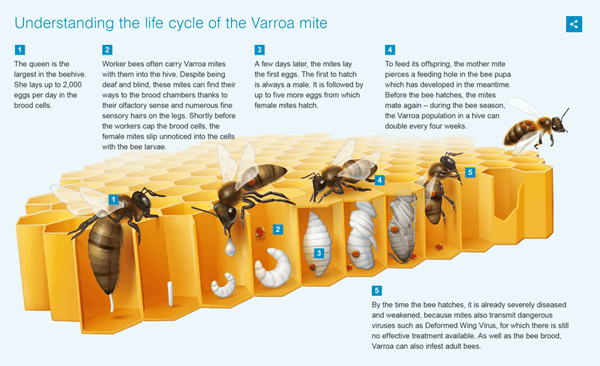
The parasite preys on both adult honey bees and their brood. Varroa females can also survive outside the brood cells by attaching themselves to adult bees. However, the parasite only reproduces in the sealed brood cells of the honey bee. Shortly before the brood cells are capped, the Varroa female mites enter and crawl to the bottom of these cells – they protect themselves from the bees that tend to the brood by hiding under the larvae. Here they first immerse themselves in the liquid brood food. Once this is depleted, the Varroa mite feeds directly on the bee larvae. The parasite has strongly adapted to its host in terms of habitat and food.
THE VARROA POPULATION CAN DOUBLE EVERY FOUR WEEKS DURING THE BREEDING SEASON. IT CAN GROW FROM 50 MITES UP TO AROUND 3,200 MITES FROM THE BEGINNING OF FEBRUARY TO THE END OF AUGUST – WHICH ENABLES IT TO WIPE OUT EVEN A STRONG BEE COLONY OVER THE WINTER.
Transmission of Honey Bee Viruses
Unlike its South-East Asian counterpart, the Western honey bee lacks sufficient defense mechanisms to fend off the non-native parasites. Infested honey bees are weakened as a result of the mites feeding on their hemolymph, which puts a strain on the bees’ immune system. This adversely affects their performance and shortens their life span. When the parasite feeds on the larva, it also transmits dangerous viruses directly into the bees’ hemolymph. The viruses can spread and harm the bees during their vulnerable development stage. Varroa increases the extent of the infection, because in the hemolymph, many viruses become deadly. Since there are no effective medicines to treat honey bee viruses, control of the Varroa mite to reduce the spread of viruses is essential. One such virus that is very widespread is the deformed wing virus (DWV), which can occur both in the brood and in adult bees. Often an infection does not produce any visible symptoms, but if the parasite transmits the virus to bee pupae, the young bees will develop deformed wings. These bees are unable to fly – and have a shortened life span compared to healthy bees. The Varroa mite also transmits other viruses such as the acute bee paralysis virus (ABPV), which can infect adult bees and larvae alike. It is primarily found in fat body cells and in the bees’ salivary glands, but does not produce any typical signs of disease. The mite transmits ABPV directly into the bees’ hemolymph. From there it spreads to the vital organs: once in the brain, the virus induces behavioral disturbances and impairs orientation and development – all of which can have lethal effects on the bees. An infection with ABPV is particularly critical in the case of winter bees – it severely affects their ability to survive until spring.
THE VARROA MITE HARMS HONEY BEES IN VARIOUS WAYS: – IT WEAKENS THE BEE’S IMMUNE SYSTEM, CAUSING DISEASE PROGRESSION TO BE MORE ACUTE. – IT TRANSMITS VIRUSES THAT SPREAD QUICKLY WITHIN AND BETWEEN BEE COLONIES. – IT TRANSMITS VIRUSES DIRECTION INTO THE BEES’ HEMOLYMPH – PREVIOUSLY HARMLESS VIRUSES CAN THUS BECOME LETHAL.
Infection with the Varroa mite
The varroa mite spreads from hive to hive through contact with bees from other colonies, even to colonies located several miles away. During natural and assisted reproduction and robbing, the varroa mite travels on the back of the host bee to nearby hives, where it continues to multiply and spread.
Combatting the Varroa mite
When it comes to improving honey bee health, one of the main activities of beekeepers in Europe and North America is fending off the Varroa mite. In fact, the beekeepers’ most important task – particularly in late summer – is to minimize the level of colony infestation. This is crucial to ensure that sufficient numbers of bees survive the cold months of the year, thus enabling a strong colony to develop again in the spring.
Homelabvet has some tips on this.
There are some quality and effective medicines that you can use against Varroa mites:
What role do animals play in the coronavirus pandemic?
As the death toll of COVID-19 keeps rising, scientists now are still uncertain about the origin of the novel SARS-CoV-2 virus. This virus is the youngest in the family of coronaviruses known to infect humans and animals alike. It is believed that the pangolins and bats [Rhinolophus] that were sold in the wet market of china are the most likely candidates. One study indicated that a coronavirus [BetaCoV/RaTG13/2013] found in bats [bed reservoir] shared 96% of its genetic material with the virus [SARS-CoV-2] responsible for the current pandemic, COVID-19. But this particular bat virus is unlikely to have infected human cells directly, suggesting that the virus jumped to humans via another animal, the pangolin. Due to mutations, the same virus developed the ability to infect humans. All coronaviruses are lethal but there are always the ones that are more harmful because of how easily they can be transmitted. When a virus jumps from animal to humans it is called a zoonotic virus. But the infection is not just limited to humans as there are reports of it spreading to other animals.
SARS-CoV-2 Infection in pets.
Studies and risk factors:
A tiger at the Bronx Zoo, New York City has tested positive for COVID-19 after developing a dry cough. A small number of lions at the same zoo also showed signs of infection.
There are several reports from countries like Hong Kong where dogs have tested positive without manifesting any of the usual symptoms. Scientists also believe that cats are very susceptible to the SARS-CoV-2 virus. Such circumstances have caused panic among pet owners as they wonder what this means for them and their pets.
Caretakers and their vets are curious about how the virus can affect the livestock. Although, pigs, chicken and ducks are not likely to get infected according to the research papers released from china and the Republic of Korea. There are clear hints that pets can contract the infection from their SARS-CoV-2 infected owners, but the claims are more obscure due to lack of research.
Precautions and quarantine:
The current events are shocking enough to rattle pet owners. Following the statistics, it will not be surprising to see many reports of such cases shortly. Studies have hinted that the transmission is of a reverse zoonosis type, where pets are at the risk of getting infected from positive SARS-CoV-2 owners and not the other way around. It is thus safe to conclude that both human and animal species are facing a greater risk. Therefore, during the quarantine phase, you should consider the needs of your pets and prepare accordingly.
Exposure and care
The first symptoms that appear after a possible SARS-CoV-2 infection are dry cough and fever. If your pet develops the following symptoms or seems more lethargic than usual it is important to take the advice of your veterinarian. The period for which the virus can survive on the surface of your pet’s body depends on factors such as humidity, temperature, and nature of the surface. But the current understanding denies the possibility of transmission of the infection from pets to their owners. Comparing the larger number of cases of positive COVID-19 humans and the small number of pet infection. It is improbable that your pet will be infected or can transmit the disease to others.
Should your pet exhibit symptoms of SARS-CoV-2 infection, contact your veterinarian immediately for further advice. According to the data gathered from the few animal cases, it is seen that the symptoms are mild. Therefore, all COVID-19 positive animals need is rest and recovery. In case of a more severe incident, your veterinarian will consult with the animal and public health officials on the course of action.
SARS-CoV-2 infection in farm animals.
Studies and risk factors:
The SARS-CoV-2 has shown an adequate ability to evolve and adapt in an intermediate host before reaching humans. The receptor sequence binding to SARS-CoV-2 in animals and humans is remarkably similar, suggesting that there is a weak species barrier for the virus to transmit to farm animals. The members of Coronaviridae cause respiratory and intestinal infections in animals. Introductory data shows that the spike protein of SARS-CoV-2 is cleaved by the enzyme Furin during its biosynthesis. This is similar to the avian influenza viruses, which acquire a polybasic structure if introduces in poultry farms and yet again cause a deadly outbreak of a highly pathogenic virus.
ANGIOTENSIN CONVERTING ENZYME-2 commonly known as ACE-2 is a single-pass type 1, an integral membrane protein that covers the entirety of a cellular membrane [transmembrane protein]. It has a key expression in vascular endothelial cells, renal cells and Leydig cells of the testis. Analysis via Polymerase chain reaction [PCR] revealed it is also expressed in cells of the lung and gastrointestinal tract. Angiotensin II is the major substrate of ACE-2, meaning it negatively regulates the Renin-Angiotensin System.
ACE-2 and SARS-CoV-2
Evidence reveals that the SARS-CoV-2 virus also uses ACE-2 as a receptor for entering the cells. There are similarities between the mechanism of viral entry into different cells between humans and animals. This creates a better foundation to the factorize a higher probability of the same virus infecting humans due to contact residues that have been found between Spike protein and ACE-2.
The ACE-2 in humans is glycosylated at following binding sites – N53, N90, N322. N53 did not give similarities in any animal species. N90 was not the site for glycosylation in ACE-2 in the following animals – mouse, pig, racoon, civet, fox, and chicken. N322 was not the site in mouse, rat, cattle, sheep, and pangolin.
But the big risk arises after it was found that some species have additional glycosylation sites in the same region. In chicken residue, L79 is a potential site with M82 being the sites in pangolin and rat. Drawing from the results, the most interesting is the ACE-2 proteins in farm animals and pet cats, as they are the next plausible reservoirs of SARS-CoV-2. Until now, there are chances of minimal exchange and therefore does not pose an intermediate threat of infection.
It should be reflected that for generations cattle producers have been dealing with infections in farm animals from different strains of coronaviruses. Animals caretakers and veterinarians have come across coronavirus infections in swine – porcine epidemic diarrhoea [PED] virus and Transmissible Gastroenteritis [TGE] virus and in companion animals – Feline INFECTIOUS peritonitis [FIP] virus. As discussed above, the difference in protein structure and varying sites, show that there is a lack of consistency in the types of vaccines used in animals, which means the evidence of its usefulness in humans is even more variable.
Precautions and quarantine:
Practising precautionary measures during the pandemic will guarantee that there is a secure, safe, and stable food supply. Preparing well in advance for plausible viral interactions in livestock should include maintaining a proper source for feeding and medications. In case, any abnormal behaviour is detected, or if any unit of the livestock shows the usual symptoms of COVID-19 disease, it is best to inform your veterinarian as a better effort towards disaster management.
Drugs and SARS-CoV-2 VIRUS
The present fight against the pandemic caused by the SARS-CoV-2 virus has been solely dependent on prevention and containment. But there is hope as more and more existing drugs are showing positive results towards inhibition of the SARS-CoV-2 virus. One such drug that surfaced quite recently is Ivermectin. It is an FDA- approved drug used for parasitic infections. It was originally known to be an inhibitor of the interaction between the HIV-1[Human Immunodeficiency Virus-1] protein and the importer protein [IMP ɑ? 1]. Its inclusion on the WHO model list of essential medicines makes Ivermectin widely available across the globe.
Ivermectin is responsible for opening the glutamate sensitive chloride channel currents in helminths, which is believed to be the reason why it shows such anti-parasitic activity. It is the drug of choice for the treatment of Onchocerciasis and Strongyloidiasis, both of which are parasitic infections. It is also effective against several intestinal nematodes including Ascariasis, Trichuriasis, Cutaneous Larva Migrans, Wucheria bancrofti, Brugia malayi, Masonella ozzardi and Loa loa. It is also used for the treatment of scabies and head lice.
The reason why ivermectin might be effective against the SARS-CoV-2 infection.
Once the SARs-CoV-2 virus enters the cells of a body using the H2 receptor, it releases its messenger RNA into the same cells. The infected cell then starts to translate the messenger RNA from the virus which leads to the production of viral proteins responsible for the formation of new viral cells. New viral proteins then enter the nucleus, impairing the ability of the host cell to fight the infection. Scientists believe that the viral proteins enter the nucleus of a cell through specific channels made up of Importin [Protein]. There are various forms of Importin proteins namely, Importin Type alpha [imp alpha] and Type beta [Imp Beta]. It is in this process of nuclear entry of the virus where Ivermectin has an inhibitory role. It inhibits the passage of the viral protein into the nucleus. It does so by binding to the protein channels, effectively blocking the passage of the SARS-CoV-2 viral proteins from the cytoplasm into the nucleus of the cells, in vitro. Scientist at Monash University, Melbourne, were able to demonstrate that Ivermectin killed COVID-19 virus growing in cells of primates in a culture dish. A single dose of ivermectin had a 5000-fold reduction in virus levels at 48 hours in cell cultures. Justifying that this drug has a significant impact on SARS-CoV-2, in vitro.
The drug Ivermectin, therefore, shows ample basis for further investigation for use to cure COVID-19 patients. Other drugs that have been investigated in clinical trials against SARS-CoV-2 virus are Remdesivir, Chloroquine and Hydroxychloroquine.
Although, Ivermectin is shown to be effective in a laboratory environment, is still cannot be used in humans who have tested positive for COVID-19. The potential operation of the drug to combat COVID-19 needs funding to conduct clinical trials to confirm the effectiveness of the drugs at levels that are safe for human dosing.
Based on what is already known, the most common adverse reaction of ivermectin is the Mazzoti reaction. The compromise takes place only when ivermectin is used for the treatment of Onchocerciasis, a parasitic infection.
The Mazzoti reaction was first described in 1948, it is a symptoms complex seen in patients after the treatment of Nematode infestation. This was seen to occur particularly with the medication diethylcarbamazine [DEC] and the same symptoms occurred with Ivermectin. Mazzoti reactions are known to be life-threatening, characterized by symptoms such as fever, hives, generalized swelling, swollen lymph nodes, tachycardia [fast heart rate], hypertension [low blood pressure], joint pain and abdominal pain. Whilst using Ivermectin to treat onchocerciasis particularly, there is a 25% chance of Mazzoti reactions and 2% chance of diarrhoea. Treating COVID-19 with the same drug it is unlikely that Mazzoti reaction should surface. Ivermectin should not be administered to pregnant or lactating women and to children weighing less than 15 kilograms.
Conclusion
The emergence of SARS-CoV-2 is definitive of the firm relationship existing between animal and human health, conditions in the ecosystem and human habits. It is strongly agreed that many viruses have existed in their natural reservoirs for a great deal of time. The constant jumping of the same viruses from their natural hosts to human species and other animals is mainly due to factors such as modern agricultural practices and urbanizations. Therefore, it is safe to say that the most constructive method of preventing viral zoonosis and reverse zoonosis is to maintain these barriers between human society and natural reservoirs. Despite the probable animal origin, the SARS-CoV-2 virus causing COVID-19 has not yet infected many animals including companion animals and farm animals, although human cases are now quite common. But there is a need to observe and investigate all animal species that are in close contact with humans for signs of infection. The current situation is saturated with vulnerabilities if new evidence emerges in terms of the virus behaving differently than what is expected.
Starbucks, Subway and McDonald’s have made no animal welfare progress in eight years
Our Animal Protection Index (API), which ranks countries on their laws protecting animals, exposes the drastic need for global change
Holding countries to account
For the API, we assessed the animal welfare policies and legislation of 50 countries and ranked them from A (the highest score) to G.
Shockingly, no country obtained an ‘A’ grade.
Some countries such as Morocco, Iran, Algeria, and Belarus were found to still be missing the basic legal framework needed to protect animals, and others do not formally recognize animal sentience in their existing legislation.
Sweden, United Kingdom, and Austria are rated with the highest scores, which is encouraging. More countries need to follow their lead.
We are calling on all governments to immediately improve their animal welfare standards, not only for the benefit of animals but also to reduce the risk to public health.
Coronavirus and other concerns
Severe animal welfare concerns from intensive farming, wildlife markets, and associated trade are all proven threats of disease outbreak, such as the most recent global epidemic, coronavirus.
The API found that China, USA, Vietnam, Egypt, Azerbaijan, and Belarus need to do more to protect animals and people from the threat of zoonotic diseases.
This global threat will continue for as long as there is no effective legislation and preventative measures to control the emerging threat to animal and people’s health.
Beyond public health, these systems which put us all at risk are causing immense suffering and cruelty to billions of animals every year.
We need to build a better world for animals and people, but this won’t be possible until we stop treating animals as commodities.
Does the life of an animal mean nothing at all?
Last year we launched a film to highlight the many ways that we are failing to protect animals, asking the question: does the life of an animal mean nothing at all?
This is a question we need to ask governments lacking even the most basic animal welfare policies.
As COVID-19 keeps us apart, we will let the animals in
First, the eyes. I pressed mine to the opening of a little wooden house. The park ranger behind me cleared her throat.
“Yeah, watch out because they jum–”
The shiniest eyes bugged out, followed by a little furry body.
An Australian northern quoll is fast, spotty and critically endangered. Ginger Meggs landed deftly on my neck, scuttled across my shoulders and flattened his body against my wrist. Normal quoll behaviour?
“He’s feeling your pulse,” the ranger told me. She asked if maybe I was a calm sort of a person because he stayed there, belly warm against wrist, reading my blood. No one has ever described me as calm. In the human world, I’m excitable. But maybe in quoll time my big human heart is languid, lazy.
I was living alone in a caravan in the Northern Territory Wildlife Park at the time, researching my novel about communication between humans and animals, which begins, a little too presciently, with a new flu pandemic sweeping the country. Ginger Meggs was living alone in an enclosure. We paused there together, sharing my heartbeat.
But now, in the age of coronavirus, we all live alone. Or with a couple of people, max: our bubble buddies that we are happy to share germs with and no one else. While we keep apart to protect each other, there are still many moments of connection online. We can watch author Miranda July dance in her loungeroom. We can learn how to do the #BlackfellaHug on NITV, celebrate Jacinda Ardern or deplore Scott Morrison together on Facebook. But on the last day of on-site work, I can’t hug my crying colleagues. I recently moved from Melbourne to regional New Zealand and can’t get to my family across the deep Tasman Sea. And I can’t cope with the thousands who have already died from coronavirus.
In my riverside town, people tended to holler “hello” of a morning. This week, they’ve been inadvertently reduced to a whisper, as though even a greeting might imply inappropriate social contact. Our bodies move awkwardly in public – we don’t know how to communicate togetherness and solidarity while being so physically separate.
But then a woman appears on the river bend, easy limbed, with a dog keeping pace. She doesn’t break her stride when she sees me, she smiles; she’s not alone because she’s with a dog. And that dog wags, showing us how to be in the world.
“You know who this is all working out very nicely for?” author Ella Holcomb posted online, “PETS! VERY nicely indeed.”
Another Twitter user had to take their dog, Rolo, to the vet because he sprained his tail from excessive wagging at his suddenly homebound humans. (Rolo now has an Instagram account.)
Meanwhile my cousin jokes that, “While the rest of NZ was panic buying toilet paper and tins of tomatoes, we panic bought a dog!”
Dr Liz Walker, CEO of RSPCA Victoria, tells me over a stuttering Zoom connection that, “People with pets have higher self-esteem, are less likely to be depressed, and cope with grief and stress more effectively than non-pet owners. Especially now amid Covid-19, animals give us a sense of connectedness. No matter how bad it gets, animals make you feel safe, they make you feel happy and they’re always glad to see you.”
As countries close down and our home lives get smaller, I too “joke” with my partner that now is the exact right time to rescue a rabbit. I imagine long days of watching Cottontail chewing the furniture and pooing on the rug. And indeed, pets are generally good. For us. But – and if I didn’t think so much about this I’d have a Cottontail with me right now – what about the animals? How do they fare in this new world paradigm?
Dr Siobhan O’Sullivan, an animal welfare expert from UNSW, says that in times of crises, “we’re looking out for the humans, but animals are considered dispensable for some. There’s no doubt that you’re still vulnerable when you’re a nonhuman animal, even as a companion animal”. Some people, for instance, have asked vets to put pets to death because they’re concerned that they might carry the virus. New research that cat-to-cat transmission is possible not only increases fear, but makes a pet’s position as beloved family member increasingly tenuous. When it comes down to it, will we continue to protect our companions?
Walker agrees that while it’s natural to seek support from your companion animal, “it’s also important to prioritise downtime for everyone, including animals, so that when this ends – and it will – animals can cope with the changesin the household. Cats sleep for 18 hours and if you’re home when you were once out, you’re disturbing their sleep patterns. I would get cranky too!”
If we’re to eradicate coronavirus globally, isolation will drag into months; for some of us, the birds that we see hanging around outside the window could become our only non-screen living contact for the day. Maybe having more time to watch animals and observe that they have their own lives and needs, will give us a new appreciation for them. “That feeling of connectedness that you get from animals, and watching them do their thing … it’s extremely comforting. A lot of people get a whole lot of joy out of watching animals experience happiness and freedom,” Walker says. Can we stop, look around ourselves, realise that we aren’t the centre of the universe, and try to be a different way in the world?
Our Zoom chat is broken by a terrifying screech as the New Zealand government sends an emergency alert to every mobile phone in the country, marking the beginning of phase four: total isolation: “Follow the rules and STAY HOME. Act as if you have Covid-19. This will save lives”. For the next four weeks, I’m allowed to see people on the screen and my partner in person – no one else.
But I know that when I go for my sanctioned solitary river walk, I will still see life. Everywhere. Like a scene from the novel I just published, where a strange new flu enables us to understand other animals, my senses will be heightened to them. In the skies, crawling between rocks, hopping in the long grass and waddling at the end of a lead. From their perspective, my presence might mean very little – they have their own thing going on – but my heartbeat will slow, calm for a moment. It will mean the world.
• The Animals in that Country by Laura Jean McKay is out now through Scribein paperback or as eBook
Researchers at Monash University found Ivermectin can kills COVID-19 cells
The anti-parasite drug killed off the cells within two days and is widely available
Scientists are moving towards human trials but expect it to be at least a month
An anti-parasitic head lice drug – Ivermectin available around the world has been found to kill COVID-19 in the lab within 48 hours.
A Monash University-led study has shown a single dose of the drug Ivermectin could stop the SARS-CoV-2 virus growing in cell culture.
‘We found that even a single dose could essentially remove all viral RNA (effectively removed all genetic material of the virus) by 48 hours and that even at 24 hours there was a really significant reduction in it,’ Monash Biomedicine Discovery Institute’s Dr Kylie Wagstaff said on Friday.
While it’s not known how Ivermectin works on the virus, the drug likely stops the virus dampening the host cells’ ability to clear it.
The next step is for scientists to determine the correct human dosage, to make sure the level used in vitro is safe for humans.
‘In times when we’re having a global pandemic and there isn’t an approved treatment, if we had a compound that was already available around the world then that might help people sooner, Dr Wagstaff said.
‘Realistically it’s going to be a while before a vaccine is broadly available.’
Scientists expect it could be at least a month before human trials.
Before Ivermectin can be used to combat coronavirus, funding is needed to get it to pre-clinical testing and clinical trials.
Ivermectin is an FDA-approved anti-parasitic drug also shown to be effective in vitro against viruses including HIV, dengue and influenza.
The study is the joint work of Monash Biomedicine Discovery Institute (MBDI) and the Peter Doherty Institute of Infection and Immunity.
The study findings have been published in Antiviral Research.
Ivermectin is used to treat head lice, scabies, and river blindness and is widely available.
You can buy different types of quality Ivermectin of different brands at Homelabvet, you can buy the drug in powder, in tablets, in oral or injectable solution.
Freelancer journalist makes a personal little research about how and from what countries people search about COVID-19 treatment, so the popular words of searches are farmaco ivermectin, ivermectin coronavirus australia, antiviral research, antiviral research ivermectin,ivermectina covid, monash university, monash university covid, ivermectin comprar, farmaco coronavirus, ivermectina covid 19, messaggero, ivermectina comprar, ivermectin, who makes ivermectin, ivermectin kills covid, ivermectin SARS cov 2, ivermectin y coronavirus, cura coronavirus, ivermectina compresse, ivermectina nombre comercial, biomedicine discovery institute and etc…
As we can see by this research language the most searches are made from Italy and US.
For example, if you need you can buy different products with this main ingredient:
In the middle of a pandemic, it’s those closest to us that we worry about most: our friends, families and… pets.
The most pressing question for many pet owners is whether their beloved animals can catch the new coronavirus.
The World Health Organization says no.
There is no evidence to suggest that COVID-19 in the form it appears in humans can be passed onto companion animals and similarly, no evidence of a pet transmitting the virus to humans. So even if you have the disease, you shouldn’t worry about passing it to your pets.
But senior vet Sean Wensley, who works for veterinary charity PDSA, says regular hygiene measures are still important.
“There’s no evidence of any ongoing transmission of the disease by our pets,” he told Euronews.
“Nevertheless, as we seek to understand the disease, we think it’s really important that we apply the usual hygiene measures that we ought to be applying all the time, so washing our hands before and after contact with our pets, their leads, their food, their poop, but that’s just all good precautionary advice.”
Even if our pets don’t seem to be physically threatened by the disease, there’s still the matter of making sure they’re cared for properly while under lockdown. In most European countries that have introduced mandatory social-distancing measures, there are exemptions to the stay-inside directive if you need to walk your dog. But it’s important to keep the walk as short as possible and avoid other people. Most parks and dog run parks are closed to keep human contact to a minimum.
“When we’re able, if we’re not self-isolating because of suspected signs of coronavirus, and are therefore still able to take our dogs for a walk, we should make sure they’re kept on a lead, we wash our hands before we take them out and we crucially keep them two meters distance or whatever your local government advice is, away from other dog walkers,” explained Wensley.
If you’re self-isolating because you think you might have COVID-19 but can’t keep a greyhound indoors all day with you, it’s okay to reach out for help, said Wensley. Asking a friend or family member to take your dog for a walk is a good move, as long as both people take precautions.
Again, pets can’t get the disease, but items like their collar or lead could transmit it if an infected person touches them.
“That person shouldn’t come into your house, you should maintain a two-meter distance from them, and just be sensible, wash your hands, wipe your pet down, before you transfer them, ask them to bring their own lead with them.”
And just like us, pets aren’t overly fond of big changes in routine. Whatever lockdown measures look like in your household, it’s likely that the routine isn’t exactly the same as it was before the pandemic. That could be a recipe for stressed-out pets, according to Wensley.
“For some pets, having people around in the house that they wouldn’t normally have, perhaps children, if there’s a change in routine that can be stressful for some of our animals. Cats are particularly prone to that.”
“The one top tip I would give for those pets, and indeed all pets actually, because of the change of routine, is to make sure they’ve got somewhere that they can go to get away from the rest of the household and commotion, if they want to.”
Whether it’s a pet bed, or under your bed, Wensley said it’s important to identify a place where your pet can minimize their stress.
“I think we all need to in these trying times,” he said.
Coronaviruses are a large family of viruses. Some cause illness in people, and others cause illness in certain types of animals.
Coronaviruses that infect animals can sometimes be spread to people, but this is rare.
We do not know the exact source of the current outbreak of coronavirus disease 2019 (COVID-19). The first infections were linked to a live animal market, but the virus is now spreading from person to person.
CDC is aware of a very small number of pets outside the United States reported an external icon to be infected with the virus that causes COVID-19 after close contact with people with COVID-19.
We do not have evidence that companion animals, including pets, can spread COVID-19.
We do not have evidence to suggest that imported animals or animal products imported pose a risk for spreading the 2019 novel coronavirus in the United States.
Further studies are needed to understand if and how different animals could be affected by COVID-19.
Coronaviruses are a large family of viruses. Some coronaviruses cause cold-like illnesses in people, while others cause illness in certain types of animals, such as cattle, camels, and bats. Some coronaviruses, such as canine and feline coronaviruses, infect only animals and do not infect humans.
Risk of animals spreading COVID-19 to people
Some coronaviruses that infect animals can sometimes be spread to humans and then spread between people, but this is rare. Severe acute respiratory syndrome (SARS) and Middle East respiratory syndrome (MERS) are examples of diseases caused by coronaviruses that originated in animals and spread to people. This is what is suspected to have happened with the virus that caused the current outbreak of COVID-19. However, we do not know the exact source of this virus. Public health officials and partners are working hard to identify the source of COVID-19. The first infections were linked to a live animal market, but the virus is now spreading from person to person. The coronavirus most similar to the virus causing COVID-19 is the one that causes SARS.
The virus that causes COVID-19 spreads mostly from person to person through respiratory droplets from coughing and sneezing. At this time, there is no evidence that companion animals, including pets, can spread COVID-19 to people or that they might be a source of infection in the United States.
Risk from imported animals and animal products
CDC does not have any evidence to suggest that imported animals or animal products pose a risk for spreading COVID-19 in the United States. This is a rapidly evolving situation and information will be updated as it becomes available.
Regulation of imported animals and animal products
The U.S. Centers for Disease Control and Prevention (CDC), the U. S. Department of Agriculture (USDA), and the U.S. Fish and Wildlife Service (FWS) play distinct but complementary roles in regulating the importation of live animals and animal products into the United States. CDC regulates animals and animal products that pose a threat to human health; USDA regulates external icon animals and animal products that pose a threat to agriculture; and FWS regulates external icon importation of endangered species and wildlife that can harm the health and welfare of humans, the interests of agriculture, horticulture, or forestry, and the welfare and survival of wildlife resources.
Stay healthy around animals
In the United States, there is no evidence to suggest that any animals, including pets, livestock, or wildlife, might be a source of COVID-19 infection at this time. However, because all animals can carry germs that can make people sick, it’s always a good idea to practice healthy habits around pets and other animals.
Wash your hands after handling animals, their food, waste, or supplies.
Practice good pet hygiene and clean up after pets properly.
Talk to your veterinarian if you have questions about your pet’s health.
Risk of people spreading COVID-19 to pets
CDC has not received any reports of pets or other animals becoming sick with COVID-19 in the United States.
CDC is aware of a very small number of pets outside the United States reported an external icon to be infected with the virus that causes COVID-19 after close contact with people with COVID-19. To date, there is no evidence that pets can spread the virus to other animals or people. CDC is working with human and animal health partners to monitor this situation and will continue to provide updates as information becomes available. Further studies are needed to understand if and how different animals could be affected by COVID-19.
Protect pets if you are sick
If you are sick with COVID-19 (either suspected or confirmed), you should restrict contact with pets and other animals, just like you would around other people. Although there have been no reports of pets or other animals becoming sick with COVID-19, it is still recommended that people sick with COVID-19 limit contact with animals until more information is known about the virus. This can help ensure both you and your animals stay healthy.
When possible, have another member of your household care for your animals while you are sick.
Avoid contact with your pet including, petting, snuggling, being kissed or licked, and sharing food.
If you must care for your pet or be around animals while you are sick, wash your hands before and after you interact with them.
Woman and pussy: the unique tandem of cats and women has always attracted attention and generated many different theories about their relationship with each other. Although cats have always been distinguished by their independence and dissimilarity to other living beings, their similarities with women and their special relationship with them require a special discussion.
Pure Beauty
The main common feature that a woman and a cat have is the desire of both beauty and conquest of the world. Such a tradition originated in the depths of centuries, and even in ancient times cats were always depicted next to the most beautiful women, and any beauty was automatically compared in her grace and grace to representatives of the cat family. And, of course, cats and women always got along very well. For example, in Turkey, statuettes were found dating back to the 6th millennium BC, which depicts women playing with cats. And even then, each mistress of the house reserved for her pet the most privileged place in the house.
This is not surprising, because a woman and a cat have one more thing in common – independence, bordering on affection. It was the gentleness of a woman who always attracted a cat to her side, and thanks to this, the feline race was closely intertwined with the human one, and the cat began not only to decorate the house with itself but also to protect it from various dangers. Soon, in almost every country, special rules and laws appeared that require respectful and reverent treatment of cats:
in Britain there was a code of laws determining the value of a cat and prescribing punishment for cruelty to it;
in America, a cat immediately became an object of exchange trade, as well as the patroness of many houses, which she saved from epidemics and other disasters;
in Paraguay, at the legislative level, it has been established that every cat is worth a pound of gold;
in Ancient Russia in the 14th-century laws existed that penalized cat larceny and imposed huge fines on thieves.
And in each of the situations, the behavior of cats was not important: animals were considered sacred even when they showed their difficult character, and it was women who played a significant role in recognizing their sacred value.
Unattainable ideal
In addition, from time immemorial, women and cats have in common many common features – both appearance and character:
resourcefulness and intelligence inherent in both
quick reaction and agility,
excellent plastic
undeniable external beauty
some detachment.
Thanks to this, women gave their hearts to cats many centuries ago. And today this tradition continues, because it is in the graceful representatives of feline women that they see a real ideal, which is often unattainable for themselves.
A cat for women is a living embodiment of beauty, and the independent behavior of cats is an example to follow. This is not surprising, because:
cats do not have problems with being overweight,
cats do not need fur coats – their silky and delicate fur is admired by every one;
cats do not need to fawn in front of people to be stroked – it only allows you to do this if she liked the person;
the cat is always beautiful, no matter what she does;
the cat does not need to take care of its kittens all its life and even think about who it is pregnant from;
the cat is patient and ready to faithfully listen to all the sorrows of its owners, without giving them any stupid advice,
the behavior of cats can be anything, but no one can be angry for a graceful and touching animal for a long time.
And, of course, there are some comic “differences” between women and cats, which men often like to talk about:
the cat is fluffy throughout the body, and not just on the head,
for beauty, the cat doesn’t need makeup,
the cat remains graceful in any situation,
the cat eats less
the cat can purr beautifully,
the cat is easy to keep on your lap
if her owner gets sick, the cat will just sleep next to him, without disturbing him,
the cat will never whimper and complain
the cat is always clean and takes care of itself,
the cat will not be offended by you if you are tired and you are not up to it,
a good word will always please a cat,
the cat doesn’t need new outfits,
Getting a cat in the house is always very easy!
However, even in spite of these small “differences”, it is the woman and the cat who always get along best with each other. And even if the owner of the animal is just the man, his pet can easily neglect it, and all attention will be paid to his chosen one!
Of course, if you want your cat to feel healthy every time you should give him anthelmintic drugs and you can find a lot of different cat supplies HERE.
The varroa mites or Varroa destructor is an external parasite that’s endangering the honeybee colonies all over the globe. It was reported to be first seen in North Carolina in 1990. It was only three ago that its existence was made known to the united states. The mite weakens the bees by sucking on their fat bodies and because of their infestation, many honeybee colonies were wiped out. In the state of North Carolina, the recorded loss suggests a loss of 44 per cent of these honeybee colonies ever since the invasion. Hence, this makes it extremely important to understand the biology and workings of the varroa mites along with some effective control measures.
The biology of varroa mites.
Being external parasites, the varroa mites attack both the adult honeybees and their larvae that are still developing. The adult mites are oval and flattened in shape. They have reddish-brown coloring. Dimension wise they are 0.06 inches in width, almost as small as the size of a pinhead. The female mites enter the cell of the developing honeybee larvae to deposit a maximum of 6 eggs inside of it. As the mite develops it feeds on the pupae of the bee. If they are more mites predating on the pupae, more is the chance of the honeybee larvae dying or getting deformed. Sometimes they may not show any visual effects. The female mites of the bee larvae cell die but the male then continues to climb into the adult worker bees to feed on their hemolymph or the bee blood. The same cycle is repeated over and over by the female mites repeatedly. The male mites prefer the drone larvae instead of the worker bee larvae. But both the larvae stand at the danger of infestation is immediate control measures are not taken.
There are many indirect ways in which the mites can harm the honeybees and their colonies. Apart from feeding on the larvae bees and the adult one, these mites are a vector for many kinds of viruses that are fatal for the honeybees. the viral infection weakens the bee’s immune system and makes them prone to a condition known as parasitic mite syndrome which is deadly enough to kill an entire honeybee colony within a few months of infestation.
Methods of varroa mite detectionfor further varroa mite treatment.
Varroa destructor
Most of the varroa mite infection occurs in the months embarking late summer or fall seasons. It is complex to identify a honeybee colony with an excess of mite invasion. For this reason, it is important that bee sampling is done for the estimation of the extent to which the infestation has spread. There are several different methods through which the estimation can be done. They are as follows:
The sugar shake method: through this technique the mite prevalence in the colony is estimated. Which means the results of the percentage of the adult bees suffering from the infestation are counted.
The following procedure is followed:
1. a transparent one-pint jar with a lid with 1/8-inch hardware cloth or any other kind of mesh is taken.
2. 200 adult bees are brushed or shook from a frame with an emerging brood on the inside of the jar or the container
3. the jar lid is closed and 2 or 3 tablespoons of 6x powdered sugar is added through the mesh section of the lid.
4. the jar or container is set aside for a few minutes to get the bees fully covered with the powdered sugar.
5. the mites are dislodged, if present onto a flattened surface after the jar is shaken a few times. It is important to note that the bees now covered in sugar do not die and can be returned to their colony. It more than ten motes are found per batch of 200 bees, there is an infestation. This means that the necessary measure should be immediately taken. The mites can be viewed in more detail with the help of a magnifying glass.
The sticky board method: for the estimation of total mite load on the colony or the total number of mites present in the hives.
Here’s a simple tutorial on how to count the total mite load in a colony:
1. a sticky can easily be purchased from any beekeeping object retailer or company. The board comes with an adhesive material and a grid for sampling purposes. If it is hard to purchase a sticky board in your area, one can do it themselves with a stiff sheet of paper and some sticky material.
2. the upper surface is then sprayed with an aerosol spray or for the homemade board, a very thin layer of petroleum jelly is applied.
3. the board is placed between two mesh covers so that one mesh is on the top and the other is at the bottom of it. this is done to ensure that the subjected do no stick to the sticky surface of the board.
4. the board is placed on the lower level of the beehive. After a while, a considerable number of mites, if present will begin to fall on the board, sticking to it.
5. the board is extracted after twenty-four hours to count the mite count. In case the number of mites present on the board exceeds the count of 60 or 190 depending on the size of the colony. The necessary control measures are taken.
Using the alcohol wash: this method is quite like the sugar roll method.
Here is how it’s done in a few simple steps:
1. in a transparent jar measuring a pint, rubbing alcohol is poured up to 2 inches.
2. 200 adult honeybees are brushed in it from a frame with an emerging brood.
3. the container is school vigorously for a minimum span of 30 seconds. The container is then taken in for examination and estimation of the sunken mites at the bottom of the jar. If more than ten mites are found then the bee colony is infested needing immediate measures.
Drone brooding inspection technique: this is a less reliable method. As it cannot give an acute estimation of the mite infestation in the colony. But this is a good enough method to determine the degree of varroa mites present.
1. the drone brood located on the periphery of the hive is selected.
2. cells are uncapped for pupae removal
3. the adult varroa mites if present is closely inspected. In case there is more than 10 per cent of drones than are infested then the colony should be declared infested, needing immediate control.
Борьба с заражением клещами Varroa (рекомендация Homelab Veterinary)
Controlling Varroa mite infestation
Many beekeepers still practice the traditional method of varroa mite control. One of that is to hanging plastic strips covered in pesticide in between beehives. However, these methods have proven to be less and less effective against the infestation over the years. The mites are evolving rapidly and developing resistances against such chemicals and other forms of treatments. There was a need to come up with better and more effective techniques to fight these mites. The methods as mentioned below are either structural or mechanical. Several changes are made to the hives and the resistant stronger mites. Bio pesticide is a very useful weapon against such parasitic attacks, and much more environmentally friendly than using a harmful synthetic material.
Mechanical control
These methods are simply intended to bring some changes to the management methods of the honeybee hives. The main advantage of doing this is that these methods are completely chemical-free and poses no threat to the bees in the hive. Neither do they interrupt the regular process of honey production and collection? These tasks are more labor intensive requiring better equipment.
1. screened bottom boards: this method is proven and tested one. replacing the wooden bottom of the beehive with the screen that’s meshed or any other less solid surface. After using this technique, the studies report a considerable decrease in the number of mites. The complete reason behind remains unclear but it is suggested that better ventilation might the cause of this mite reduction.
2. drone brood trapping: as mentioned earlier, varroa mites feed on the drone larvae lymph making holes in the pupae of the honeybees. the cause of this is that the drones are relatively larger and take more time to develop. This allows the female mites to lay more eggs inside the larvae. This preference by the mites over drone bee larvae is taken advantage of. Combs with drone sized cells are placed suggestively in the hives. They attract the mites away from the hives. The control drones are then removed after mites emerge from the cells.
Inert dust: adult mites instead of travelling all over the hive with their phalanges, clinging at the back of the adult bees as transportation means. It is understandable that on covering the bees with any slippery material such as talc powder or powdered sugar will make the clinging mites to lose their grips. This is a labor-intensive technique and causes visible disturbances in the bee colonies. The only advantage being this method is devoid of the use of chemical pesticides.
Stocks of bees that are tolerant of varroa mites.
Mite treatment for bees
Advancements in biogenetics of honeybees have shown exciting and positive results at creating a batch of bees resistant to varroa mites. Scientists have worked rigorously over the years to develop mite-resistant bees. the complete understanding of this works is still vague but it is believed that the physiological and behavioral changes exhibited by these bees contribute towards their tolerance to these varroa mites. Many strains of bees known today are building mechanisms to drive the mites out of their colonies.
The Russian strain: the USDA honeybee research lab located in Baton Rouge in Louisiana, has imported a very specific Russian strain of honeybees from Primorsky which is the extreme eastern region of Russia. These Russian honeybees are known for their amazing habits of coexisting with the parasitic varroa mites. The specific species showing this biotic relation is a strain of sister honeybees called the Apis cerana. The evolution happed as the bees were exposed to the mites for a very long period which would have helped them to develop some resistance for the mites. Research suggests the Russian bees are two times more resistant than the common commercial species. They also show a considerable amount of resistance to the tracheal mites, even so, the reason behind the phenomenon remains unclear. The stronger strains are now commercially available in many regions of the united states of America after they undergo a special quarantine period.
The VSH stock of honeybees: the artificial insemination and classical breeding techniques have allowed the researchers at USDA to choose a high varroa mite resistant strain of honeybees. the bees are equipped to detect mite infestation in the cells of the developing bee pupae. They can extract the mites even before they develop completely. The stock was crossed with the commercially available bees for the integration of the stronger trains into different strains lacking it.
Biopesticides:
Can be defined as the resistant method naturally present in some strains of bees or the by-products. Many of which have proved to be useful in controlling varroa mite infestation. These pesticides are as efficient as their chemical synthetic counterparts. But these biopesticides have different production and action periods. This is an important topic of research for many bee sustenance and improvement laboratories globally.
1.Apilife VAR®, is a combination of essential oils such as thymol, eucalyptol and menthol. The product was approved by the US environment protection agency or EPA. The state of North Carolina has been using the product ever since to control infestation from both varroa destructor and tracheal mites. This product is proven to be 97 per cent effective for causing mite death. The product comes in the form of a vermiculite tablet. The tablet is broken into four pieces to be placed in all the four areas of a beehive. The pieces are wrapped with mesh material to prevent the chances of the bees chewing them. The tablets are used every week for a total period of three weeks. The tablet’s functions at a very specific temperature ranges of 60 degrees to 90-degrees. the product can also be fatal for the bees hence it is best to use during the fall season which has the minimum amount of brooding activity. Apilife VAR®. is an organic form of pesticide however there are some restrictions on its use. It can only be purchased by people who own the NC pesticide applicators license.
2. Formic acid: after the permission was granted by the EPA to use formic acid to control varroa mite infestation in bee colonies, this method has become popular among the breeders belonging to Canada or the united states of America. There different ways of using this organic pesticide, such as pads soaked in liquid formic acid. It is advised to not use the product during honey production. Formic acid to be useful needs to have a specific temperature range between 50 degrees to 79-degrees. small colonies are often seen to be overwhelmed by the formic acid fumes. The product is highly corrosive to human beings, hence appropriate care should be taken during its application.
Chemical treatments with synthetic pesticides.
This is a traditional method of controlling varroa mite infestation is colonies of honeybees. these are truly very effective to help decrease the count of motes but there are chances that the mites can develop resistance towards such chemicals.
1. Amitraz Plus Strips: a comparatively new product in the market of pesticides. It used the chemical called amitraz to practice mite control in beehives. It works similarly as its fellow counterpart apistan.
Amitraz strips
2.Apistan®.is one of the earliest pesticides to be used for this purpose and it is registered as a by the EPA for varroa mite control. The chemical was sold in strips of plastic containing active pesticide. The strips are then hung so that they are in between two hive frames outside of the brooding nest. The product is a very strong pesticide and can get rid of varroa mites with 100 per cent effectivity of used with care.
3.Checkmite+®. This falls under the section 18 emergency category of pesticide for mite control. Quite like apistan, it comes in a plastic bag. There have been registered cases of mites developing against such products.
4.Amipol T (amitraz and thymol) is a honey bee treatment made specially to treat against Varroa Mites and the diseases they carry. This treatment is effectively carried out in the spring and autumn months when there is no brood and in bee colonies.
5. Antivaro Strips flumethrin (Flumethrinum) destroys up to 99.9% of all ticks in the hive. – The preparation is a thin wood strip impregnated with an active substance flumethrinum. – Flumetrin is a synthetic pyrethroid with a contact acaricidal effect against the Varroa destructor (formerly Varroa jacobsoni), which does not have harmful effects on bees, queens, larvae.
6. Oxalic acid, however, is entirely natural. It is an organic compound found in nature within many plants, including vegetables, leafy greens, fruits, nuts, seeds and more. Herbivores find oxalic acid repellent, which is a handy property if you are a plant!
1. varroa mites is a strain of species that now poses one of the greatest threats to the beekeepers and their honeybee colonies. These colonies if infested for a long period can wipe entire colonies.
2. beekeepers should be vigilant and conduct regular checkups of their beehives to estimate a load of varroa mites in their colonies. This helps them decide when to take the required measures to prevent the Imminent death of their honeybees.
3. using a chemical product for a long period can cause the parasite to develop resistance towards it. hence, using different products for some time can prevent them from getting resistance.
4. making use of chemicals that are not approved by responsible institutions should strictly not be used, as they may fire back and cause the death of honeybees in the colonies they are being used at.
5. understanding that chemical pesticides pose inherent risks to the bees and their hives is important. Hence, there are regulations which state that only those individuals who own some specific certifications can be trusted to handle such chemicals and put them to use. Hence, interested beekeepers should receive the necessary training through the NCDA and CS pesticide licensing program.
One of the most “vulnerable” in all plans of organs in the animal’s body is the eyes. Any of their pathologies is fraught with very serious problems, up to complete / partial blindness. Consider a situation when a puppy’s eyes watery: what to do in this case.
1 Main causes of lacrimation in puppies
2 Optimization of conditions of detention
3 Simple Eye Wash Products
4 Tearing of allergic origin
4.1 Change feed
4.2 Antiparasitic treatment.
The main causes of lacrimation in puppies
However, seeing the puppy’s tears, you do not need to panic right away. It is possible that this phenomenon is caused by completely natural, harmless reasons:
The indoor or outdoor air is dusty. Strictly speaking, this reason is not particularly harmless, since the ingress of dust into the conjunctival cavity is fraught with inflammation.
Severe emotional stress.
Heat and dry air.
In bulldogs and other representatives of brachycephalic breeds, eyes are watery constantly. This, in connection with the features of their anatomical development, is considered the norm…
But still more often watery eyes with a variety of diseases. In the case of puppies, this is especially important, since lacrimation is a common symptom of viral pathologies. And they are critically dangerous for kids.
Content optimization
Since a frequent cause of lacrimation is dryness and dustiness of the air, it is necessary to exclude the influence of these negative factors:
If possible, use a humidifier when turning on central heating.
The room must be regularly ventilated, avoiding, however, the appearance of drafts.
In the room you need to regularly do wet cleaning, avoiding extreme dust. This is especially important in the spring when the air contains a lot of pollen from trees and flowers. This will protect the health of both pets and the owners themselves. In addition, wet cleaning is especially important in urban areas, when there is a lot of dust in the street air, regardless of the season.
Simple Eye Wash
With lacrimation of the eyes, it will not hurt to rinse them. Washing will remove contaminants and allergens from the conjunctival cavity (if any). At home, you can use the funds from the assortment of a regular first-aid kit. They are inexpensive and quite effective with timely use:
Normal saline. Yes, it does not have anti-inflammatory and antibacterial properties, but it perfectly flushes out contaminants from the conjunctival cavity. Before use, the solution is heated to 37 ° C.
If there is no saline solution at hand, the use of distilled or boiled and settled water is permissible. It also needs to be heated.
A solution of furatsilin. It is better to buy it in finished form at the pharmacy, warning the seller that it is required for washing the eyes (the concentration of furatsilin solutions for different purposes differs).
Eyes can be washed with tea leaves (leafy, not from bags). This tool can be used no more than four times a day because increasing the frequency of treatments often causes dry eyes.
A solution of chlorhexidine 0.05%. A drug in such a concentration is better to buy in a pharmacy; it is problematic to make it yourself. You can wash your eyes with a decoction of chamomile and oak (1: 1), up to three times a day. This composition has a good anti-inflammatory, bacteriostatic and healing effect.
Lacrimation of allergic origin
If the puppy’s eyes began to water suddenly and in the spring, or lacrimation appeared after the baby went outside, it makes sense to suspect an allergic reaction. Of course, it is better to consult a veterinarian right away, but if this is not possible, you can help your puppy yourself:
Pets of small breeds are given ¼ tablets of diphenhydramine; larger puppies are allowed to give up to ½ tablets.
In the same doses, Suprastin can be given. If within about one and a half hours from the moment the pill was delivered, there are no visible improvements, then lacrimation is probably not caused by allergies. Feeding a puppy with antihistamines is harmful and useless, you need to call a veterinarian.
If within about one and a half hours from the moment the pill was delivered, there are no visible improvements, then lacrimation is probably not caused by allergies. Feeding a puppy with antihistamines is harmful and useless, you need to call a veterinarian
Feed change
If the puppy’s eyes began to watery during accustoming to a new feed, or during the transition to adult food, we recommend immediately changing the diet. There is no need to immediately rush for special hypoallergenic food. It is enough to first change the brand or manufacturer. If this does not help, we recommend consulting your veterinarian nutritionist and allergist.
Antiparasitic treatment
It is very likely that chronic, sluggish allergic reactions are a consequence of the presence of parasites in the puppy’s body. They can manifest themselves not only in the form of lacrimation but also in a strange rash on the stomach and groin. Again, we warn that sudden tearfulness can be a sign of dangerous viral pathologies, and therefore the puppy should be shown to the veterinarian anyway!
There are a lot of different quality medicines at homelabvet.com.